
Capital University, OH
Capital University used Envisio to build, launch, and publicly track Capital Rising, its five-year strategic plan, in President Dr. Jared R. Tice’s first year.
Capital University, Columbus, Ohio
Higher Education
Turning a strategic plan into a system for executing it.
Capital University, an independent university of about 2,400 students in Columbus, Ohio, needed a strategic plan that would move past planning into implementation and carry the institution into its 2030 bicentennial. With Envisio, President Dr. Jared R. Tice and the University’s strategic planning task force went from adoption to a full five-year plan, nearly 300 initiatives from across campus, and a public dashboard preview for the Board in about four months.
Capital University: From planning to rising
“What does it mean to be entering into your third century while being grounded firmly in your history, your mission, your values all the while still being open to innovation and creativity in the future?”
That’s the question Dr. Jared R. Tice, Capital University’s 18th president, is asking. It’s the question guiding Capital Rising, the ambitious strategic plan Capital built (and launched) in Dr. Tice’s first year on the job, using Envisio to build, track, and report on it every step of the way.
An ambitious first year
Capital is an independent university in Columbus, Ohio, and was recognized this year by The Princeton Review as one of the 2027 Best Colleges for undergraduate education in the United States. Columbus is the 15th largest city in the United States, one of the fastest-growing cities in the Midwest, and a top 20 city for young professionals. Founded in 1830, Capital enrolls about 2,400 students. It boasts a nearly 200-year-old seminary and a law school with close to 500 students, and it employs about 330 full-time faculty and staff.
| 1830 Founded | ~2,400 Students | ~330 Full-Time Faculty and Staff |
Dr. Tice became Capital University’s president in August 2025. He came to Capital from Catawba College in North Carolina, where he served as Senior Vice President and Chief Strategy Officer.
The University’s Board of Trustees, made up of 20 volunteer members, laid out an ambitious agenda for his first year, and a strategic plan for the University topped the list. The plan needed to advance key institutional priorities, including enrollment and retention, academic innovation, campus investment, the employee and student experience, fundraising, and the University’s long-term reputation.
To bridge the gap between where Capital was and where it wanted to go, Tice, along with the strategic planning task force, moved quickly to collaborate with faculty and staff to create a five-year strategic plan using a “purpose, people, pursuits, place, and resources” framework. It’s a successful structure Tice had developed and used at Catawba, adapted to fit Capital’s mission, values, and identity.
The “Before” Picture
The ideas were there, but the challenge was bringing them together into a single, actionable strategy.
Looking back at the University’s past strategic planning efforts, Tice pointed to a few recurring obstacles. They’re the same ones, he notes, that often stall plans at institutions across higher ed.
- No system for accountability. “Oftentimes what is called strategic planning software is actually more like modified project management software and doesn’t really have some of the tools that a true strategic planning software does,” Tice said. “Without a system to track deadlines, updates, and reporting, previous plans had nowhere to live.”
- Limited campus-wide ownership. “If you don’t have support for a shared governance model from your faculty, staff, and administration from across the University, you will struggle to have a fully thriving strategic plan,” Tice said. “It’ll feel like it’s the president’s plan, or the administration’s plan, or the cabinet’s plan, and not the University’s plan.”
- Plans that went static. Once finished, plans “get developed, they go into a binder, they get set on a desk with no mechanism for revisiting or updating them as circumstances change,” Tice said.
Before Envisio, Tice recalled one longtime member of the Capital community explaining that previous planning efforts established important priorities. What had been missing was a consistent system for carrying those priorities through implementation, measurement, and continuous improvement.
Choosing Envisio again
Tice had onboarded Envisio once before, at Catawba College, several years earlier. But rather than bring it to Capital University on his own authority, he appointed a strategic planning task force made up of representatives from across the University, so that staff, faculty, and administrators from every part of the institution had a voice.
That task force vetted the available strategic planning software on the market, and the co-chairs landed on Envisio.
“The co-chairs really identified Envisio as not just the best software, but the best partners. The partnership matters just as much, if not more, than the process. Envisio’s people really felt like they had a stake in our success. And that really stood out to us throughout the software search.”
Why Envisio for Higher Education
Tice sees Envisio’s value to a university split into two parts: one internal, one external. And both, he says, speak directly to problems that are specific to higher ed right now.
Internal value: One plan instead of a hundred disconnected ones
Universities are complicated organizations, made up of units with very different roles and different ways of measuring success. “You think about the accounts payable and business office. It’s very different than the academic programs of accounting and business,” Tice said. “So many departments and administration offices operate differently. But how do they contribute to the overall success of the University?”
Left alone, that complexity tends to produce separate plans, tracked independently from one another, and in inconsistent formats.
Tice sees Envisio’s job as solving exactly that:
“Envisio creates the organizational tool that allows multiple areas of the University to clone or map directly into the institutional plan. Now each employee at the University can see themselves in the plan, and how they’re contributing to the overall strategic direction.”
External value: Answering higher ed’s transparency problem
Tice points to a conversation happening across American higher education right now, one about institutions not being transparent about their outcomes and their direction.
“Higher education is facing increasing expectations for transparency,” Tice said. “With Envisio, we’re able to demonstrate not only where we’re going, but how we’re progressing toward those goals.”
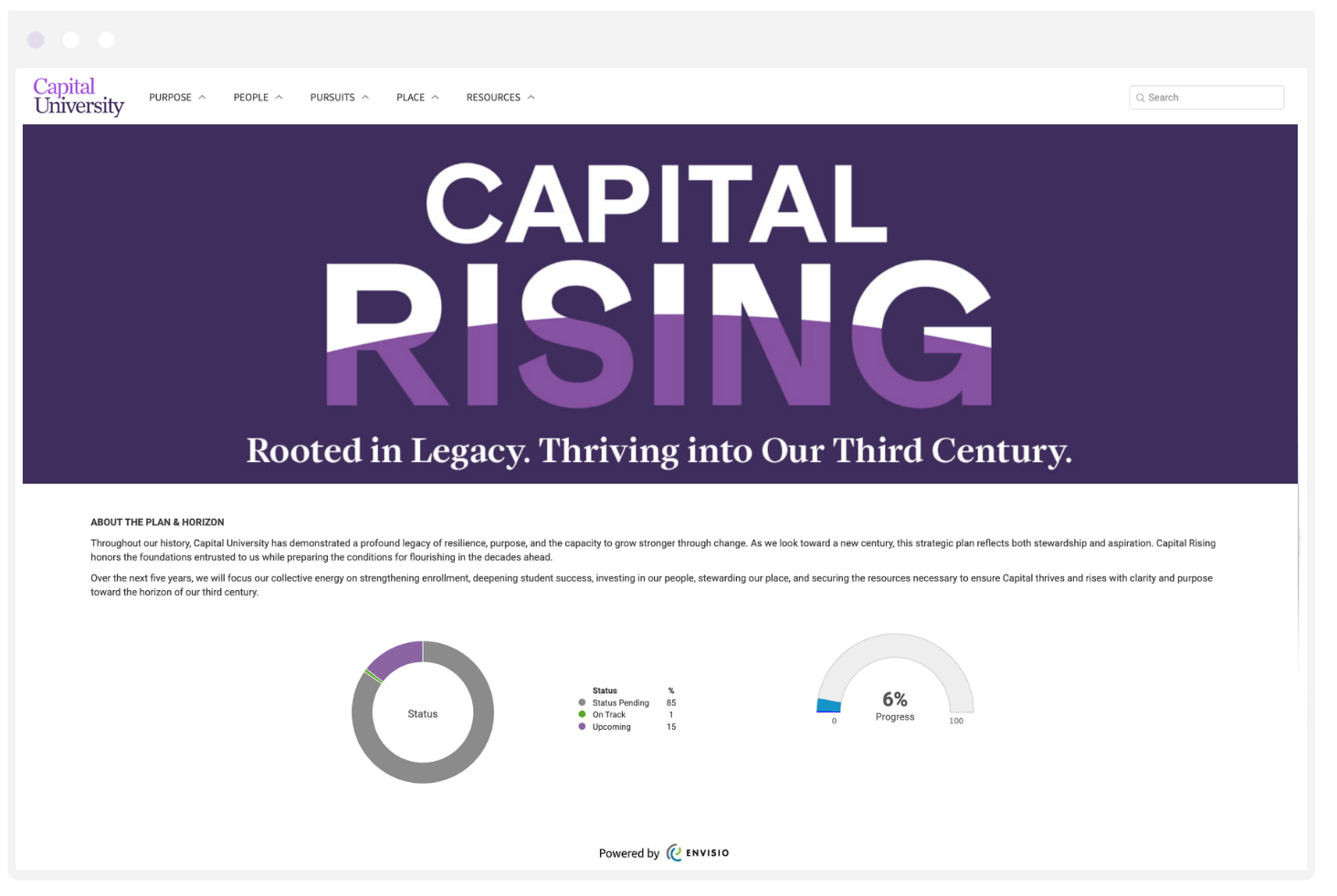
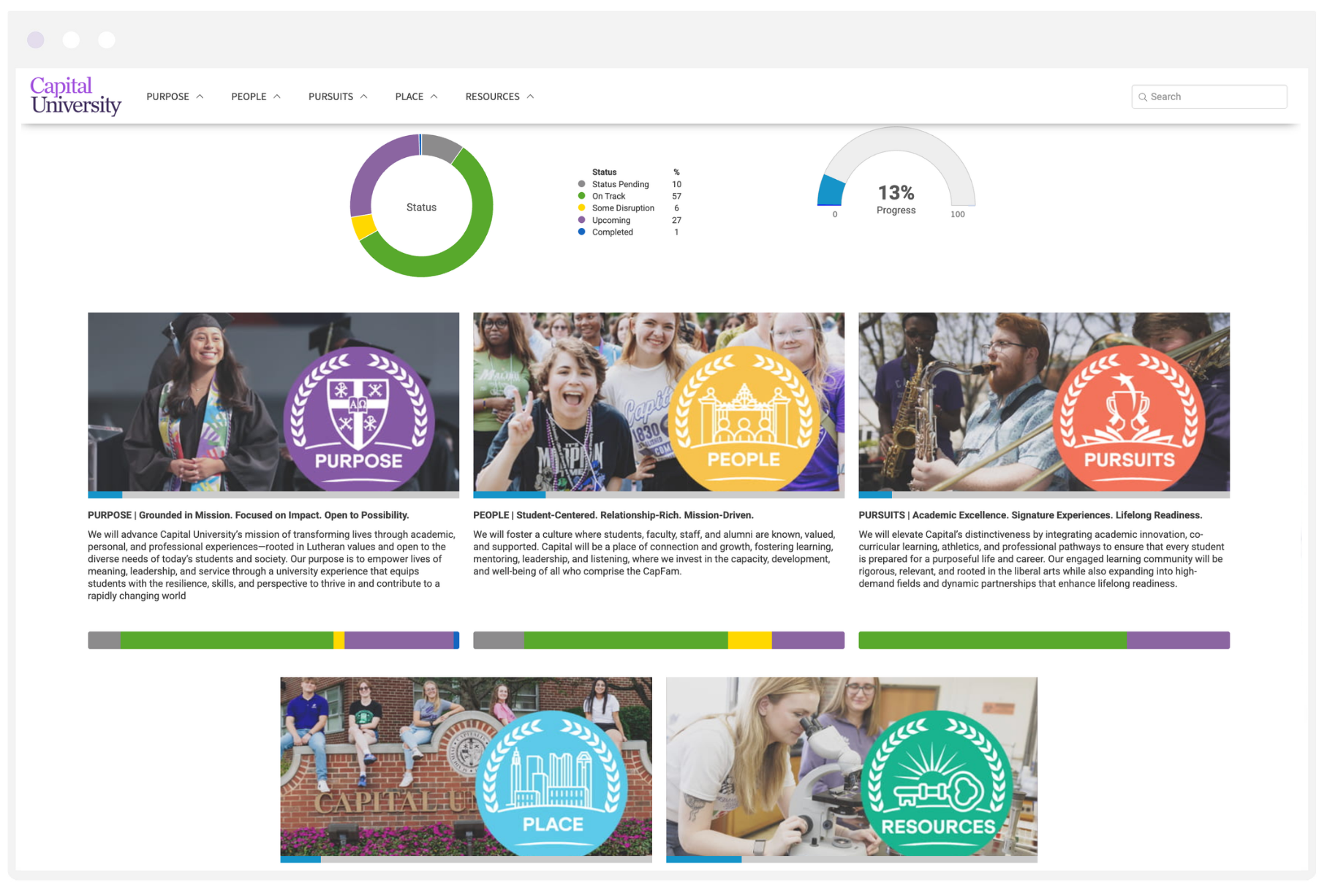
To support that commitment, Capital launched a public Envisio dashboard that openly shares the University’s five-year strategic priorities, performance metrics, and progress.
“With Envisio and the public dashboard, we’re able to demonstrate, nearly in real time, not only what our metrics are but what our aims are. That differentiator is really helpful as higher education continues to face questions about transparency. We can show where we are today, where we’re headed, and how we’re measuring our progress along the way.”
Big goals on an accelerated timeline
The numbers tell their own story. Tice joined Capital on August 1, 2025. The University adopted Envisio in early March 2026. By June, Capital brought a full strategic plan, including every cascading plan beneath it, to the Board for approval, and previewed the dashboard at the same meeting.
| ~4 Months From Adoption to Board Preview | ~300 Initiatives Submitted | 5-Year Strategic Plan |
“To be honest, that’s the hallmark of Envisio,” Tice said. “We went from adopting Envisio in early March, to building out our strategic plans and even previewing the dashboard for the Board in the June meeting, about four months. I asked a lot of my team this spring, and they delivered.”
Two onboarding changes that sped things up
Tice made two deliberate changes to how he approached onboarding Envisio the second time around:
- He brought more people from across the University into the onboarding process from the start, rather than limiting it to cabinet-level leaders.
- He asked each area of the University to identify one or two people who would own the day-to-day management of their plans. From past experience, he’d learned that the individuals closest to the work are often the ones best equipped to keep a strategic plan current and moving forward.
“I think those two elements really helped accelerate the plan building,” he said. He also credits the onboarding experts at Envisio for walking the University through the platform and making space in every session for questions.
This is the support Tice ties directly to Envisio itself:
“I have to comment on how easy it is, but also how accessible, how engaging, and how thoughtful the entire Envisio team is. The support they showed in the past has been consistent with the onboarding process here at Capital.”
The plan comes from everyone
Rather than dictate initiatives from the top down, Capital gave divisions, departments, and teams an aspirational framework and asked them to define their own contributions to it. These are all mapped back to the University’s plan.
The response: nearly 300 initiatives submitted from across the University through Capital’s intake form, many of them approved because the teams behind them had thought through resourcing, cost, and capacity.
Tice is quick to credit the University’s faculty and staff for both the plan’s content and its execution, all while Capital was managing a mid-cycle accreditation review, a first-year student experience redesign, and new executive hires in the same spring semester.
“They rose to the occasion because they care deeply about the success of our institution, our mission, our values, and the student experience.”
Even the plan’s branding, including the Capital Rising name, logos, and website, was designed in-house, without outside consultants. “That really is a testimony to the strength and the quality of the faculty and staff at Capital University.”
But Tice is careful to note that the ideas alone weren’t new. What changed is what happens to them now. “With Envisio coming in, that transitions those elements from just being great graphics and great words that are inspiring, and initiatives that allow people to think innovatively and creatively, into real, tangible, actionable items with next steps and deadlines and timelines in which we’re going to accomplish those things.”
What’s in the strategic plan
A few initiatives Tice highlighted:
- Entrepreneurship and an innovation incubator out of the School of Management and Leadership, tied to Columbus’s growth as a hub for new business.
- Presidential Leadership Fellows, a program Tice proposed himself, offering both a student leadership cohort and a track for high-potential employees to take on University-level responsibilities.
- New success programs from the law school aimed at improving student outcomes.
- A varsity esports program, announced mid-year, with the esports complex now under construction. “With Envisio projects, we’re able to actually track and keep up to date where we’re at with that particular project,” Tice said.
Built to Stay Living
Capital shares plans across the University, so every employee can see what every other department is working on.
“That’s for three reasons,” Tice said. “One, we believe in transparency. Two, we believe strongly in collaboration. You might find another plan and realize we should partner because we have a similar idea. And three, to spur innovation and creativity. We’re all in this together as a university, so we should plan together.”
The intake form for new initiatives stays open year-round, so ideas can be vetted and folded into the plan as they come up, rather than waiting for the next planning cycle. And when metrics shift, Capital isn’t erasing the record. “We’re not going to remove the original numbers. We’re going to keep those in, because that’s transparency and accountability to us,” Tice said.
“The strategic plan is a living plan for us. It’s not a static plan. And Envisio actually is the vehicle that allows it to be a living plan, with updates, with assessments, with metrics and KPIs.”
That continuity matters beyond the current year.
“As people retire, depart for new opportunities, or we create new roles, people can come in and be trained quickly on Envisio. They have this arc and repository of information across the institution, which I think is really nice and makes us much more efficient,” Tice said.
Tice hopes the Capital Rising public dashboard doesn’t just inform people, but moves them to act.
He said, “Hopefully it’ll inspire some people, maybe among our alumni and donors, to give some resources, or at least inquire like, hey, I like that initiative, what would it take for me to get involved?”
Pursuing a legacy of performance excellence
In a single, unified debut, the University unveiled its five-year Capital Rising vision alongside a website and the public-facing performance dashboard. The timing isn’t incidental: Capital turns 200 in 2030, and this plan carries the University into its bicentennial.
“We’re at a pivotal time in the University’s history,” Tice said. Students joining Capital this fall “will work until likely 2070 or 2075. We need to be preparing them not just for their first job, but to be adaptable, creative, curious, so they can navigate their careers successfully.”
As for the plan’s success, Tice returns to the same thing he keeps coming back to: the people who built it.
“Our faculty and staff here at Capital University built this plan. And they should take pride in that.”
For Capital University, strategic planning is no longer a periodic exercise. It’s an ongoing, transparent process that connects every department to institutional priorities and provides the accountability needed to turn ideas into measurable outcomes. As Capital approaches its bicentennial, the University has built not just a strategic plan, but a system for executing it.
Capital Rising in action
Capital University shares its five-year priorities, metrics, and progress with alumni, donors, and the public.
-

Capital University embedded their dashboard on their Capital Rising app. -