Picking strategic planning software is a big decision, and it’s a hard one to walk back once your whole team is living in a tool. So it’s worth getting right.
The best platforms give you a single place to build plans, assign ownership, track KPIs, and report progress to the people who need to see it — whether that’s an executive team, a board, elected officials, or the public.
Envisio is our platform, so we’ve put it first in the list. But Envisio works only with public sector organizations, so we’re not the right fit for everyone. Where another tool is the better call — especially for private sector teams — I’ve said so.
This guide compares five of the best strategic planning software solutions on the market in 2026.
How We Compared These Platforms
Every platform on this list is purpose-built strategy management software — designed for planning, execution, and performance reporting.
This article does not include general project management tools (Asana, Monday, Smartsheet) that can track tasks but aren’t designed to manage strategic plans, KPIs, and multi-audience reporting.
For each, we looked at:
- Planning architecture:single plan vs. multi-plan portfolios, and which frameworks the platform is built around
- Reporting and dashboards:internal roll-up reporting and external/public-facing analytics dashboards
- Pricing model: per-seat vs. unlimited users, and what that means for adoption
- Sector fit — who the platform is actually designed for
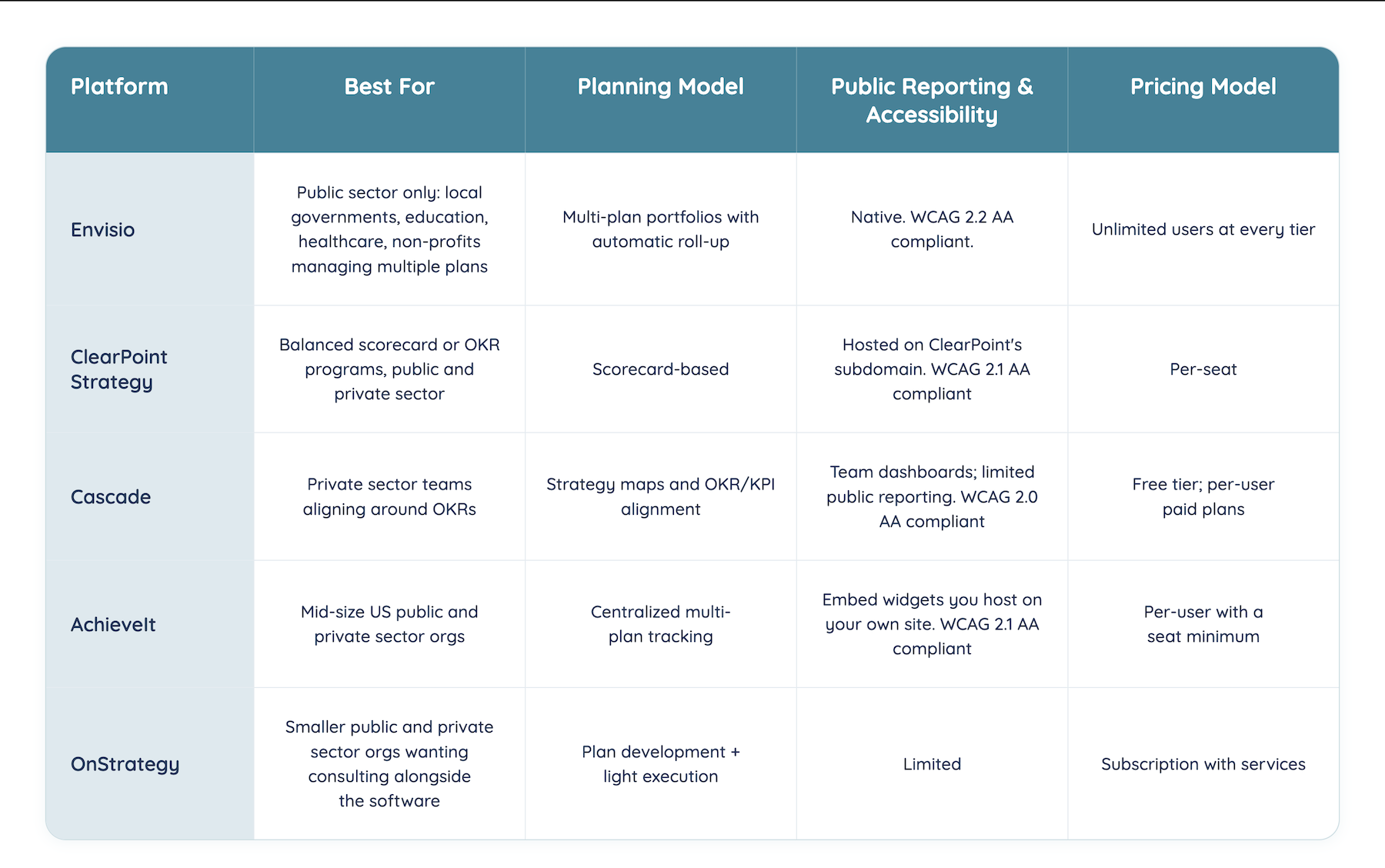
Quick Comparison
Envisio — Best Strategic Planning Software for the Public Sector
Envisio is a strategy, performance, and analytics platform built exclusively for public sector organizations: local governments, school districts, healthcare organizations, and non-profits.
The company’s exclusive focus on the public sector shapes everything about the product, from its planning architecture to its public-facing analytics dashboards.
Most government and education organizations aren’t managing a single strategic plan. They’re managing a portfolio — strategic plans, departmental work plans, capital improvement programs, individual school plans, climate action plans, performance measures, and more, often interconnected and running on different cycles. Envisio is built for this: 67% of Envisio customers manage an integrated planning portfolio on the platform.
Key features:
- Multi-plan management with roll-up reporting. Update an action or KPI once and see it reflected everywhere it’s linked across all your plans. Get visibility into your entire plan portfolio using the multi-plan management views and roll up updates into reports for different audiences — from a departmental work plan all the way up to a strategic priority. Organization-wide visibility without manual consolidation.
- Public-facing performance dashboards. Publish analytics dashboards with KPIs, progress indicators, narrative updates, and maps directly to your own website (including your .gov domain).
- Public sector project management. Track projects, budgets, and project status on map-based dashboards with the option to link project updates to strategic goals and other plans.
- Integrations built for public sector tools. Pre-built connections to common public sector tools, including Polco Track, Questica, Microsoft Teams, and Power BI, plus an open API. Envisio can ingest data from any application that pushes data out. The API is available to every customer.
- Accessibility is built in, not an add-on. Dashboards meet WCAG 2.2 Level AA standards and audited natively by an independent accessibility auditor (BarrierBreak). A VPAT is available for your procurement team.
- AI-assisted reporting. Envisio AI summarizes staff progress updates across an entire plan into executive summaries for council packets, leadership meetings, and public dashboards — turning hours of reading and writing into minutes. Recommended workplans can be auto-generated based on Envisio’s large public sector database.
- Unlimited users at every pricing tier. No per-seat pricing means no financial penalty for organization-wide adoption.
- Coaching and customer success built in. Beyond software training, Envisio’s success team helps with the parts of public sector strategy work that are the most challenging — building effective action plans, refining performance measures, and setting the right reporting cadence for staff, elected officials.. Most of this support is included for customers, with paid dedicated workshops available, plus self-guided and peer-led learning through the Envisio Academy.
Envisio is a GovTech 100 recognized company with a dedicated public sector research team. .
Customer data is hosted in the US by default, with in-country hosting available for Canadian and Australian public sector organizations.
Considerations: Envisio works exclusively with public sector organizations. If you’re a private sector company, we’d encourage you to look at ClearPoint Strategy, Cascade, or AchieveIt below.
Best for: Cities, counties, towns, special districts, school districts, higher education, healthcare organizations, and non-profits managing multiple plans and reporting to multiple audiences.
ClearPoint Strategy — Best for Private Sector Balanced Scorecard and OKR Programs
ClearPoint Strategy is a strategy management software platform serving both private and public sector organizations. Its architecture is built around the balanced scorecard methodology, with more recent support for OKRs.
Key features:
- Structured scorecard management with strong support for the balanced scorecard framework
- Automated report creation, scheduling, and delivery
- Public-facing dashboards hosted on ClearPoint’s subdomain
- AI features focused on auto-suggestions and analysis, including portfolio risk detection
- Open API available at the highest pricing tier
Clearpoint is a strong choice for corporate scorecard management. It is built around private sector methodologies and nomenclature and is a powerful way to get clarity and alignment around business health and performance.
Considerations: Because every feature is scoped to a single scorecard, organizations managing multiple interconnected plans/scorecards often find cross-plan reporting requires manual work.Accessibility is delivered through a third-party overlay (AccessiBe), so this is worth checking against your procurement requirements.
Best for: Organizations of any sector that have committed to the balanced scorecard or OKR methodology and want structured, governance-friendly reporting around it.
Cascade — Best for Private Sector OKR and KPI Alignment
Cascade is a strategy execution platform popular with teams running OKRs across departments. It’s known for its alignment and relationships features, which help distributed teams see how their objectives connect to the broader organizational strategy.
Key features:
- Alignment visualization connecting objectives, initiatives, and KPIs
- OKR and KPI management with real-time progress dashboards
- Built-in collaboration tools for sharing updates and feedback
- Broad integration library (Slack, Microsoft Teams, Jira, and more)
- Free plan for up to 2 users, with platform pricing for paid tiers
Considerations: Cascade’s primary planning frameworks are oriented around OKRs and corporate strategy methodologies. Public sector teams with public reporting obligations, multi-plan portfolios, or accessibility compliance requirements might find Cascade has fewer purpose-built features for that work.
Best for: Teams that want a visual, OKR-driven approach to aligning departments around a shared strategy.
AchieveIt — Best for Driving Adoption Among Non-Technical Users for Organizations Without Deep Transparency Goals
AchieveIt is a US-based strategy execution platform with a both a private and public sector customer base. Its main feature is email-based updates that don’t require contributors to log in. If your hardest problem is getting consistent updates out of a large group of busy, non-technical staff, that approach works well. AchieveIt is FedRamp certified, so you can expect strong data governance from them.
Key features:
- Email-based progress updates, no login required for contributors
- A portfolio-level view of every plan in one place
- Configurable plan hierarchies from top priorities down to day-to-day work
- US government purchasing vehicles (GSA, NASPO, and others)
Considerations:
Similarly to Envisio, AchieveIt has a plan cascade and hierarchy architecture: both products use configurable hierarchical structures to cascade from strategic priorities down to operational work, with strong multi-plan management features.
AchieveIt is a strong internal alignment and reporting tool, but weaker when it comes to external organizational storytelling.
For organizations that have a goal of clear, structured transparency to external audiences, AchieveIt has fewer features than some of the platforms on this list. This is especially true around project-based dashboards, ADA compliance, the ability to centralize performance data, and the hosting options available for external dashboards.
Best for: US private and public sector organizations whose biggest challenge is getting consistent progress updates from a large group of contributors across many plans for internal reporting and staff alignment.
OnStrategy — Best for KPI and OKR-Centered Organizations That Want Consulting Alongside Software
OnStrategy pairs strategic planning software with hands-on consulting services. If your organization needs help developing the actual strategy itself (facilitation, plan development, goal-setting workshops) alongside a tool to manage execution, OnStrategy’s model is built for that.
OnStrategy works with both public and private sector organizations, but their focus on OKR and KPIs is generally preferred by businesses over public sector organizations.
Key features:
- Guided strategic plan development with consulting support
- Goal tracking and team accountability tools
- Quarterly review and performance reporting workflows
- Templates and frameworks for organizations building their first formal plan
Considerations: The software is lighter-weight than the platforms above on analytics dashboards, multi-plan portfolio management, and public reporting. Organizations with mature planning practices may find they’re paying for services they don’t need.
Best for: Organizations early in their strategic planning maturity who want expert facilitation built into the engagement.
How to Choose Strategic Planning Software
A few questions worth answering before you shortlist:
- How many plans are you actually managing? If the honest answer is “more than one” prioritize platforms with native multi-plan management and roll-up reporting. Retrofitting a single-plan tool to a planning portfolio is where implementations often stall. Manually updating across a set of plans to ensure consistency can be grindingly slow and inefficient.
- Who needs to see progress? If your audiences include elected officials or the public, look closely at each platform’s external dashboards: How easy are they to maintain?Are they accessible? Can they tell a story with context and narrative, or only display metrics?
- What does the pricing model do to adoption? Per-seat pricing creates a quiet incentive to limit access to the critical . If breaking down internal silos is a goal, unlimited-user models remove that friction.
- How much ongoing support is included? Initial onboarding is rarely the problem. Ask what’s included after go-live — training for new staff, help building new dashboards, best-practice coaching — and what costs extra.
A Note on Planning and Budgeting in Local Government
For local governments specifically, strategic planning software is increasingly connected to the budgeting process.
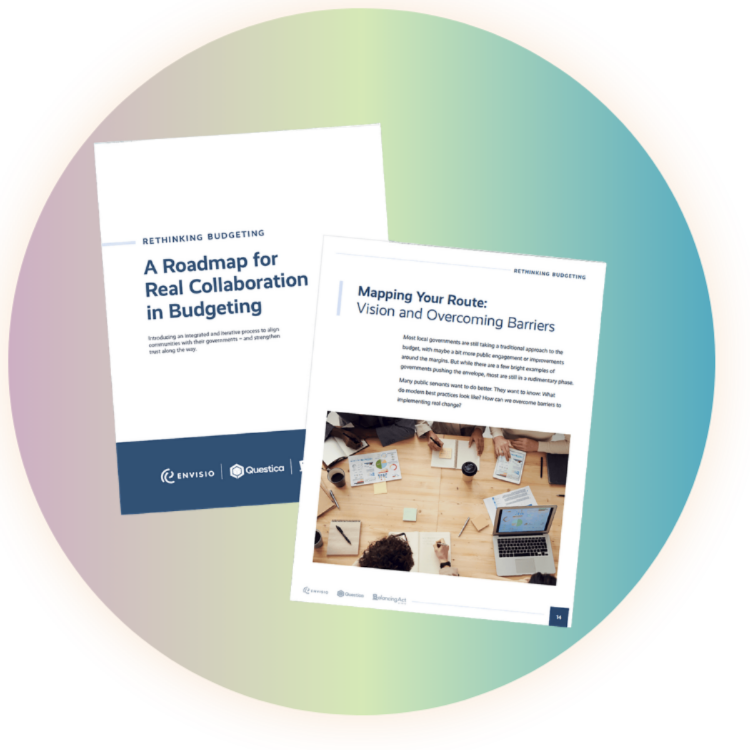
The GFOA’s Rethinking Budgeting initiative — its new local government budgeting framework approved in 2024 — calls for tighter integration between strategic priorities, performance data, and resource allocation.
If aligning planning and budgeting in local government is on your roadmap, ask vendors how their platform supports it.
Envisio team members contributed directly to the Rethinking Budgeting recommendations, and supporting them remains an area of deep focus for our team.
So which one should you pick?
Picking the best strategic planning software will come down to who you serve, how you work, and what you need.
If you’re a private sector company running OKRs against a single corporate strategy, Cascade, ClearPoint, or AchieveIt will all serve you well. Start with whichever one matches your framework and your budget.
If you’re a city, county, school district, health authority, or non-profit juggling a stack of plans on different cycles — and you’re answerable to a council or a board and the residents who elected them — that’s a different kind of dynamic. You need an architecture built for many plans, reporting that rolls up on its own, and accessible, engaging dashboards your community can use to stay informed. That’s the work Envisio is built for.
Whichever tool you choose, the goal is the same: spend less time chasing updates and writing reports, and more time on the work your community is counting on.
If you want to see how that looks in Envisio, book a demo.