If you are reading this blog, you probably work for a public sector organization and are in the process of evaluating both the Envisio and ClearPoint Strategy platforms.
This article will help you to understand the main differences between:
- The platforms themselves
- The teams behind them
- The community and resources built around each company
- The customer experience; including how quickly organizations gain value and get to desired results
There is an avalanche of AI-slop-driven misinformation about these two leading strategy and performance management platforms, so let me start by saying this was written by a human, the old fashioned way (👋).
Over the last 7+ years, I’ve had the joy of getting to know our customers, the important and fast-evolving work they do for our communities, and the difference that Envisio has made to achieving their goals. Being part of this challenging yet rewarding work – and the phenomenal people driving it on the ground – is an honor, and the reason that I love what I do.
Envisio works exclusively with public sector organizations so this article is focused on helping governments, healthcare organizations, educational institutions and non-profits make a decision between these two platforms.
(If you are a private sector company looking for a solution, then we’d suggest evaluating ClearPoint, AchieveIt, and Cascade Strategy.)
Let’s dive in.
The Big Differences Between Envisio and ClearPoint
Why do public sector organizations decide to invest in a strategic planning and performance management platform?
Usually, because of one or all of the following reasons:
-
They have tried to implement organizational strategic goals, and/or a performance management system in the past and found that using spreadsheets – and a bunch of other disjointed tools – does not support integrated planning and performance management. This makes it almost impossible to get visibility into what is happening, timely updates, and useful reports.
-
A previous plan, or set of goals, has sat forlornly on a shelf never to be heard of again.
-
They are in the midst of organizational overwhelm and fog around who is doing what, when, how, and for what purpose.
-
They are spending many hours per quarter manually producing progress and performance reports for elected officials.
-
There is a desire (or an external demand) to be more transparent about progress and performance internally, with elected officials, and with the public.
Whatever your path to this article: welcome.
It takes courage, vision, and hard work to put a strategy into action and to keep striving for better outcomes for your team and community. It is especially courageous to make those results transparent to a variety of audiences and to take the time to inform, educate and publicly adapt as things change.
Choosing a partner in this work is a big decision.
Here’s the reality: Envisio and ClearPoint both have successful public sector customers. While Envisio’s public sector customer base is bigger, both companies serve some huge counties, cities, universities and school districts, as well as smaller villages, towns, special districts and non-profits.
You can be successful with either company. Both companies get reviewed well for initial onboarding and technical support.
But there are key differences between the two platforms. The chances of success of your work—as well as just how much you enjoy doing it—hinge on understanding these differences.
The key differences between Envisio and ClearPoint Strategy affect:
- Adoption rates
- Ease of administration
- Ability to scale
- Capacity building for your team, through community and other resources.
- The relevance and quality of external “outputs” (reports and dashboards).
Most of these differences are a result of the market focus of these two companies and the way the two platforms are architected.
The Fast Summary: ClearPoint Strategy vs Envisio
ClearPoint Strategy is sold into both the public and private sectors. It is architectured around private sector planning methodologies; namely balanced scorecards and OKRs. It is great at those two things, but complex. This complexity is exacerbated for public sector organizations that typically have to take these corporate methodologies and nomenclature and make them work for public sector use cases.
Classically, the lack of public sector specific features of ClearPoint hinder adoption and scalability. This is the single most common reason that public sector organizations switch from ClearPoint to Envisio.
Envisio exclusively serves public sector organizations; namely government, healthcare, education and non-profits. Envisio is designed around public sector planning methodologies and has a strong focus on features that are critical to public sector customers, such as integrated multi-plan management, as well as multi-audience reporting capabilities.
If you take local government as an example, most government organizations aren’t managing a single strategic plan. They’re managing multiple plans, KPIs, and programs—strategic plans, departmental workplans, capital projects, performance measures, economic development, master plans, sustainability initiatives, and so on. Many plans; that are often interconnected. Envisio is natively built to support this connectivity.
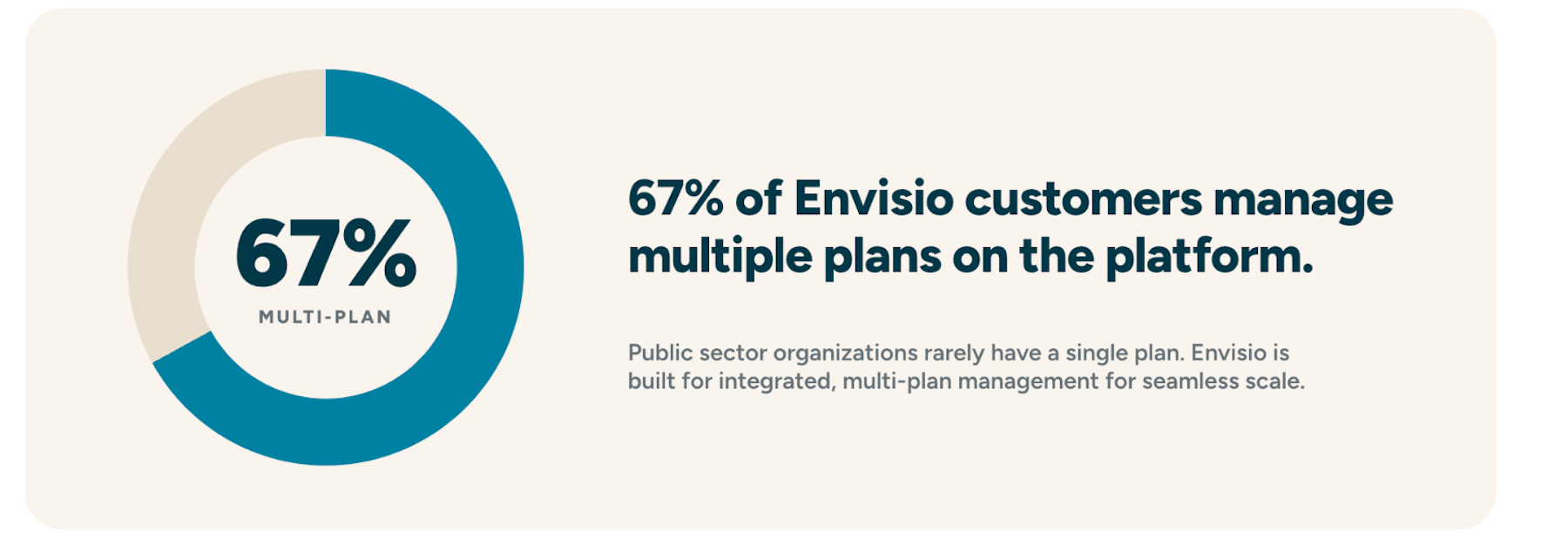
As a result, Envisio tends to scale better than ClearPoint within the public sector. Better adoption rates and stronger organizational integration. In fact, 67% of Envisio customers manage an integrated planning portfolio on the platform – not just a single plan.
“We transitioned from ClearPoint in 2023 because its pricing model and legacy dashboard platform, editable only by the vendor, could not support our evolving strategic planning and reporting needs. Envisio’s responsive customer service, intuitive dashboards, and strong consultation and training approach have made it far easier for our teams to build, align, and report on multi-level strategic plans across our organization.”
Leticia Callanen, Strategy and Performance Manager, City of Aurora, Colorado
Big Difference 1: Envisio Serves Public Sector Organizations Exclusively
Envisio is focused solely on serving the public sector – government, education, healthcare and non-profits.
ClearPoint sells to both the public and private sector.
This difference in the two companies’ focus is the underlying reason that local governments and other public sector organizations choose Envisio over ClearPoint. It is why so many switch to working with us having struggled to achieve their goals with ClearPoint.
This difference in focus influences:
- Product and feature development
- Speed to see results (“time to value”)
- The team behind the product
- The customer community
- Where research and development investment is placed
- The level of specialist support provided to you
Our mission to build trusted public agencies is at the heart of what we do. It influences everything from our hiring practices, to our product design, implementation processes, partnership network, and our customer community and research programs.
ClearPoint is a good product, but it was built to serve a very wide variety of sector needs.
Speaking as a tech executive with 25 years of experience, this “jack-of-all-trades” approach is the number one reason that software gets bloated, overly-complex, and ends up diluting customer results.
This leads me to big difference number two.
Big Difference 2: Software Complexity
The top reason customers cite for switching from ClearPoint to Envisio is that ClearPoint’s product complexity hindered organizational adoption… or prevented it entirely.
If you will allow me to take a step back for a moment.
For the last three decades in software development, we’ve talked about this idea of the “democratization” of workflows and complex tools. The idea behind this concept is that the best software should be able to take complex workflows and problems and make them simple for non-technical users.
This ability to make complex workflows feel simple is one of the biggest strengths of Envisio as a technology platform. Public sector work is unquestionably complex – with exposure to public scrutiny, layered leadership dynamics with elected officials, large budgets, multi-year strategic goals and projects, and a level of cross-departmental (and cross-sector) work not typically seen in the private sector.
Envisio has been architected to address the unique problems of public sector work, without the burden of private sector features.
This shows up as a native, integrated architecture that feels simple.
In terms of the technology itself, this translates into:
- The ability to seamlessly handle multiple plans.
- The option to update once, and reflect across all connected plans.
- Roll up reporting across an organization (from projects all the way up to strategic priorities)
- Native features to publish public and leadership-facing dashboards that tell an organizational story, without technical skills.
Clearpoint’s architecture is based on a balanced scorecard framework. More recently they have also introduced architecture to support OKRs. These are widely used planning frameworks within corporations, which are less commonly seen in public sector organizations.
You can use these frameworks—and use the ClearPoint Strategy architecture—to achieve your goals in the public sector. But time and again, we hear that this introduces additional complexity and requires a high level of knowledge, technical skill, and patience, to shoehorn private sector frameworks into public sector work.
Big Difference 3: Envisio’s Partnership Approach Leads to Adoption and Results
Typically, when strategy and performance management initiatives fail, it’s because an organization can’t consistently execute, measure progress, and communicate impact effectively. This shows up as low adoption, limited visibility, inconsistent reporting, and a lack of alignment across departments.
When you work with Envisio, we work in partnership with you to ensure you meet your goals.
One significant difference between Envisio and ClearPoint is our coaching and customer success teams. The truth is that technology alone rarely drives significant culture change.
Our Success team is dedicated to ensuring that you not only get organization-wide adoption but that you have the latest best practice frameworks – and team capacity – for effective ongoing strategy execution and performance management. One of the things we hear frequently from organizations moving from ClearPoint is that the initial implementation and onboarding was excellent, but the ongoing support was insufficient to maintain momentum or to support organizational scaling.
As well as training on the software itself, Enviso supports you in all the areas where public sector strategy and performance management work gets complicated. Most of these services are free as an Enviso customer. We also offer paid, dedicated workshops, depending on the requirements of your team.
“I can say that the strategic planning and the partnership we’ve developed with Envisio has been one of the best experiences that I’ve had in implementing a tool as a government professional. The Envisio team didn’t just give us the keys to the car, they taught us how to drive it.
Jordan Villwock, Deputy City Manager, City of Ontario, California
Examples of where Envisio provides training and ongoing professional development include:
- Developing an effective action plan.
- Refining and building effective performance measures.
- Setting the right reporting cadence for staff, electeds, and community.
- Navigating pushback against transparency
- Culture change to make strategy and performance a priority.
Envisio also provides regular self-guided training, peer-led learning, and virtual workshops for anyone in your organization via the Envisio Academy.
Whether it is presenting alongside you at a council meeting, or helping you set the right reporting cadence for your unique set of audiences, we are specialists in public sector work. We will meet you wherever you are at – and walk alongside you to where you are going.
Big Difference 4: Envisio Grows More Easily With You
Another common challenge we hear from customers moving to Envisio is around the scalability of ClearPoint Strategy. This shows up frequently in user reviews.
While two-thirds of the Envisio customer base manages more than one plan/use case on the Envisio platform, scalability of ClearPoint is often hampered by:
- Sheer complexity of the tool
- Price increases based on number of users
- Friction in bulk administration functions
- Dependency on ad-hoc consulting services to build new dashboards and train new team members.
- Lack of visibility and reporting across integrated plans
Again, this is not unexpected, given that the ClearPoint infrastructure was built to cater to private sector companies that are often managing a single corporate strategic plan.
So let’s break each of these down:
Pricing: In our work with large public sector organizations, we’ve learned that having a user-based pricing structure quickly becomes a barrier to organization-wide adoption. If you want to break down internal silos, then limiting the number of people who can access the tools for managing cross-functional work is just wildly impractical and frustrating.
Many moons ago (around the time I joined the team), Envisio used to offer this type of per-seat licensing. Truthfully, it made it easier to sell Envisio upfront, but we heard how challenging this model was for our customers as they tried to roll out the tool organizationally. It felt like a bait and switch, so we changed it. Envisio provides unlimited users at both pricing tiers.
Bulk Administration: This is one we see often in user reviews. Multiple independent reviewers of ClearPoint flag that self-service configuration is not realistic for most teams, meaning complex setups require ongoing involvement from the ClearPoint team rather than providing administrator autonomy. Envisio encourages broad use across the organization and is designed to make bulk administration functions simple and autonomous.
Consulting Services: Many of the challenges we hear from public sector organizations is around the need to keep paying for consulting services from ClearPoint. This seems to be particularly the case around creating, or changing, dashboards, as well as additional training costs.
Complexity: We’ve talked a lot about complexity. Most of this is caused by trying to mold the private sector frameworks native to ClearPoint into public sector work.
One good example of this is around the base unit that each company uses to structure work. For ClearPoint Strategy, the scorecard is the unit of everything. At Envisio, a plan, set of programs, performance measures, or group of projects can be used as the core. ClearPoint is excellent for corporate scorecard management, but it is not flexible or easy for the work of governments and other public sector organizations.
Multiple Plans: This is a huge difference between the two platforms, that we’ll explore next.
Big Difference 5: Roll-Up Reporting & Multi-Plan Management
This difference sounds small, but it illustrates a key architectural difference between the two platforms.
Envisio natively offers roll-up reporting from anywhere in your plans or other planning elements (performance measures, projects, actions etc) all the way up to a strategic goal. What this means is that an update anywhere in your organization can be rolled up to show overall progress in your reports. Importantly, you can also update in one place, and have that update reflected wherever that action/plan/program measure is used.
The Envisio model makes it much easier to connect and align departmental work, as well as to communicate organizational performance with elected officials, residents, or other external audiences.
One organization, one story.
ClearPoint is not natively built to support rollup reporting or integrated planning. It is built for corporate strategy. A plan is a scorecard in ClearPoint’s world, which is not well- aligned with most public sector organizational thinking. With ClearPoint, if you have actions or projects related to more than one plan/scorecard, the update needs to be done individually for each and every scorecard.
An Innovation Director at a large city we work with shared that when they were using ClearPoint, they were spending close to two weeks per reporting cycle manually updating their scorecards to ensure consistency.
In local government, we work with organizations who are tracking dozens of plans in Envisio, all running concurrently, but on different planning cycles, and accountable to different audiences.
These include:
- Strategic plans
- Capital improvement
- Climate action
- Departmental work plans or scorecards
- ARPA reporting
- Public safety
- Equity initiatives
- Housing plans
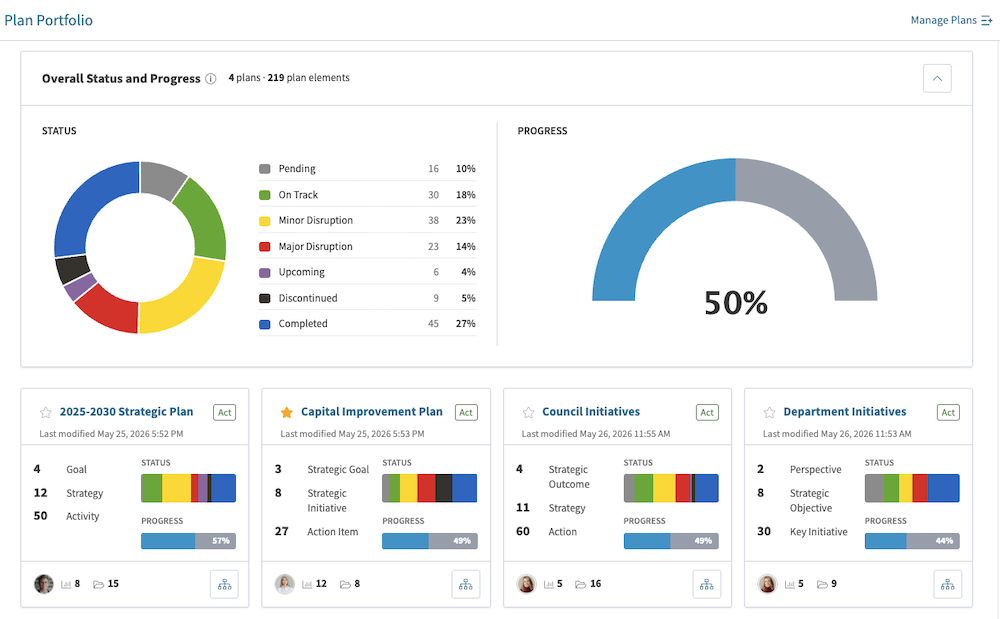
Screenshot of Envisio’s plan portfolio management features.
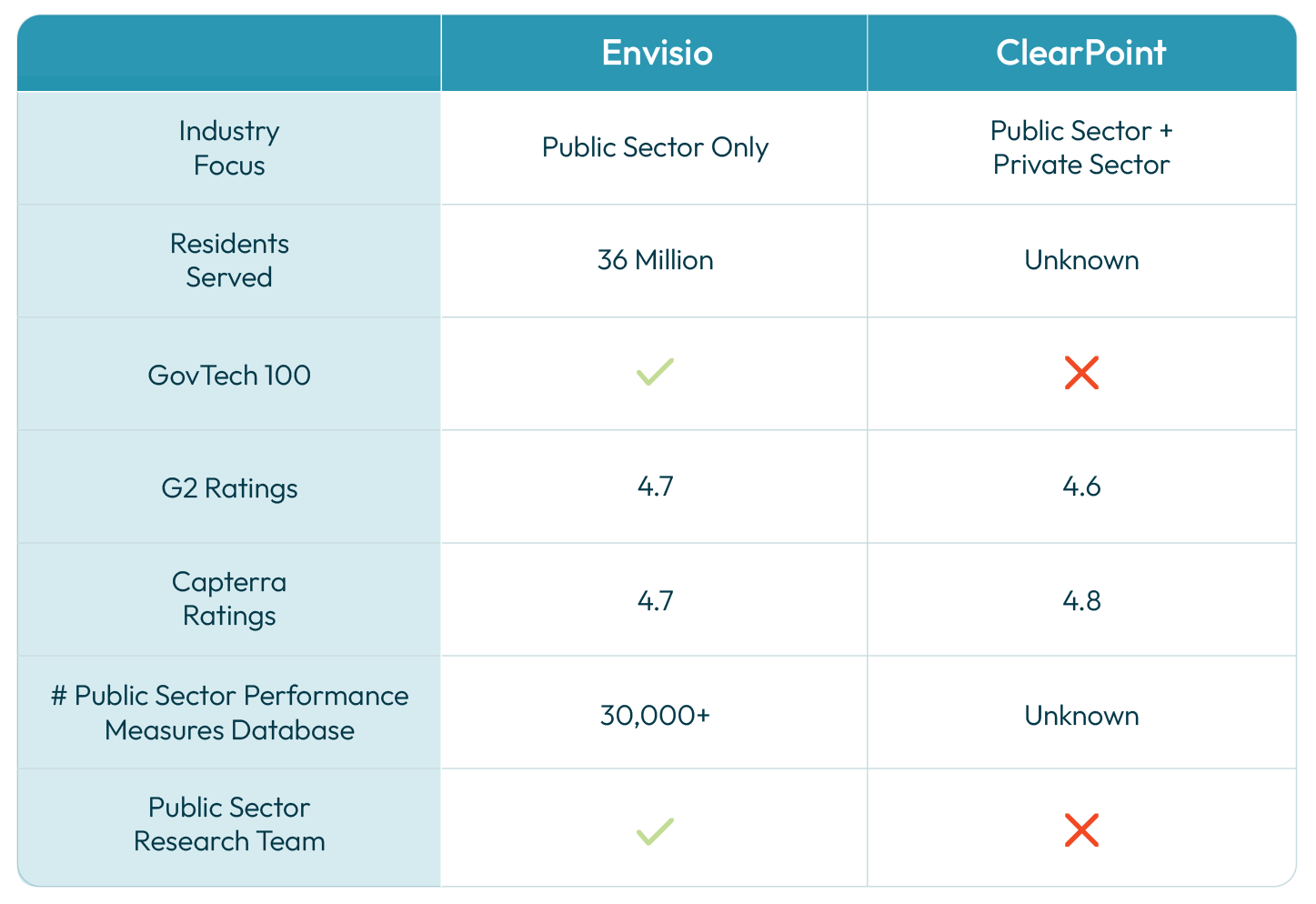
Envisio vs ClearPoint – Market Presence
A quick look at how the companies stack up in terms of market presence, reach, and impact, as of June 2026.
Envisio and ClearPoint are both very highly rated on user review platforms such as Capterra and G2. The caveat is that Envisio’s reviews all come from public sector organizations, whereas ClearPoint reviews are a mixture of both public and private sector.
Where ClearPoint Excels
ClearPoint has a large private sector customer base. If you use the balanced scorecard methodology or OKRs, ClearPoint is a solid choice.
While of course Envisio can support you to represent and manage a balanced scorecard, that is just one planning methodology; Envisio is designed to conform to your structure, not the other way around.
Where Customers Struggle With ClearPoint (Why They Tell Us They Switched)
The single biggest complaint we hear from customers who have made the switch from ClearPoint is they could not get engagement within their team or adoption stalled. For all the reasons we’ve discussed above.
We see a very steady drumbeat of customers moving from ClearPoint to Envisio. This has increased recently since Clearpoint’s last major update to launch Clearpoint Next. We have been told that a significant portion of new product releases are around porting features from the old version of Clearpoint into the new one, leaving little room for new integrated planning capabilities.
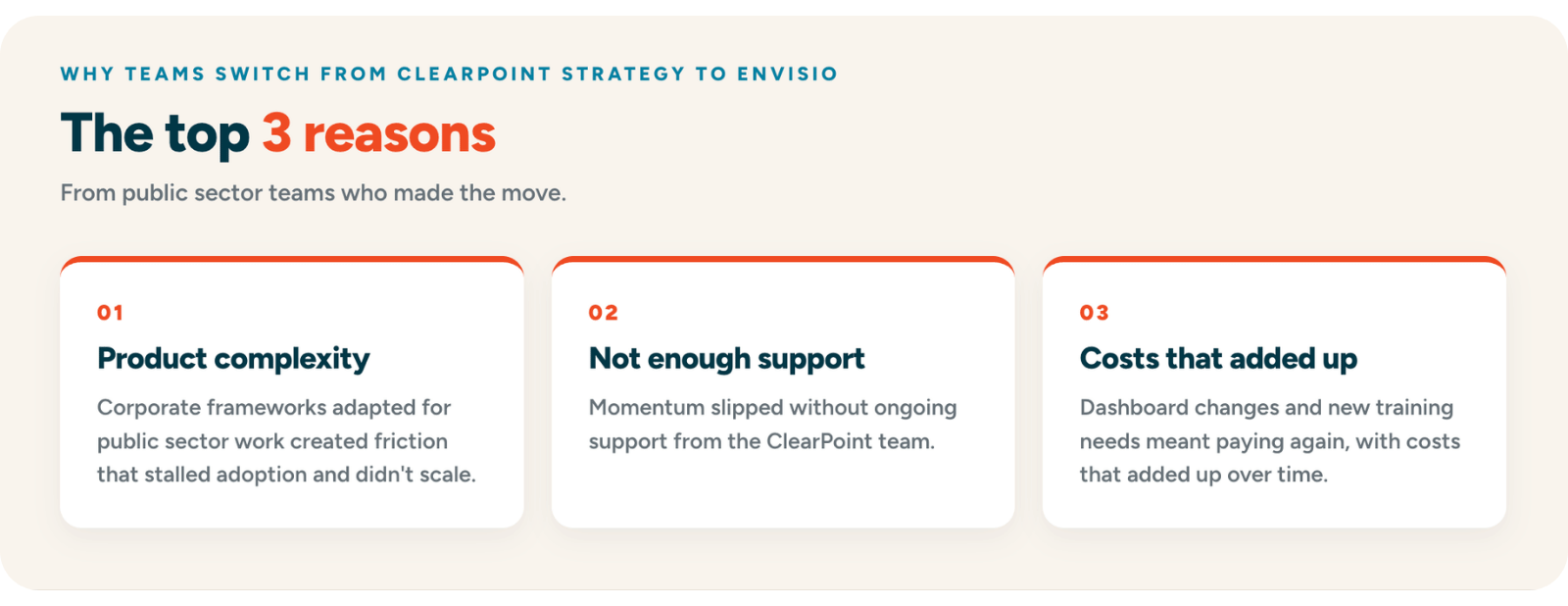
As of June 2026, the top 3 reasons that public sector organizations have told us they moved from ClearPoint to Envisio are (broadly):
- Product complexity
- Insufficient ongoing support
- Dependency on ad-hoc consulting services (and creeping costs)
Please let us know if you would like us to put you in touch with any of these organizations that made the switch as you evaluate both platforms.
Core Feature Comparison
Multi-Plan Management
Thanks to an integrated planning architecture, multi-plan management is one of Envisio’s biggest strengths.
What this looks like in practice:
- The ability to manage and maintain visibility of all of your plans from one place (your “Plan Portfolio”) without running a report
- Easily linking elements and updates between plans. Update once and update in multiple places.
- Enable true integration across your entire strategic portfolio.
- Multiplan reporting capabilities.
If you have multiple plans and projects to manage, Envisio has a much more powerful and natively connected toolkit for managing and reporting across multiple plans than ClearPoint.
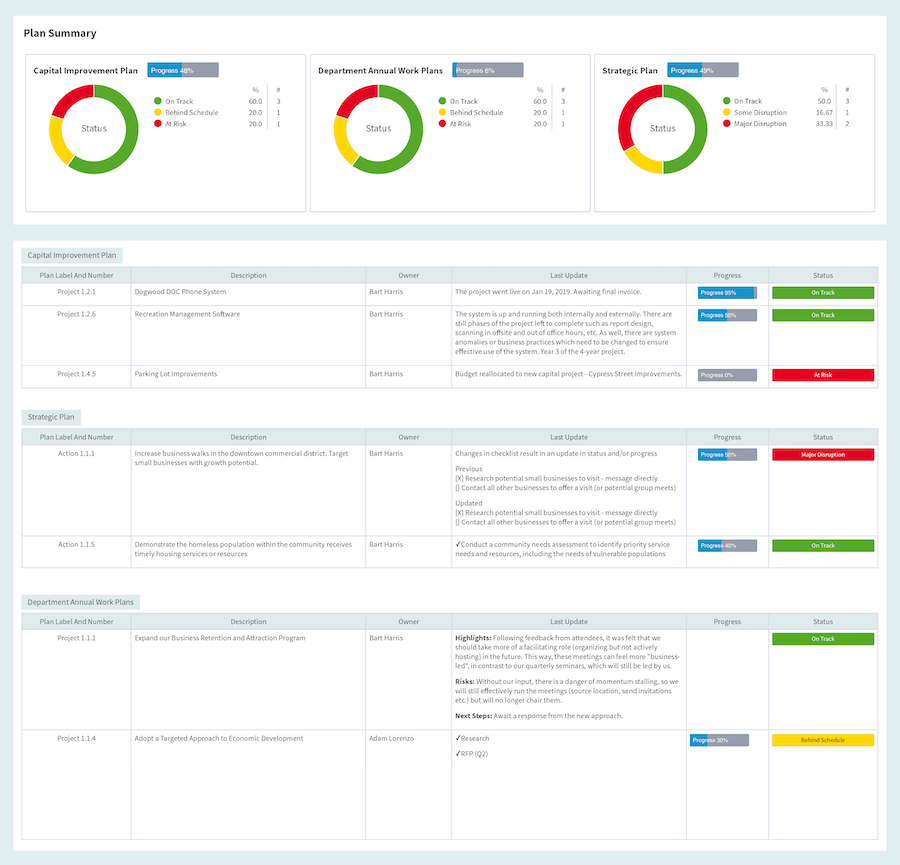
Screenshot of a multi-plan report summary generated by Envisio.
Project Management Tools
Envisio’s native project management tools are unlike any other strategy and performance management tool in the market. This is because they were designed in partnership with our customer base to address the unique challenges of public sector project management.
Envisio’s public sector project management suite is unique in three ways:
- Projects can be rolled all the way up into strategic goals where your projects have strategic alignment.
- Your projects can be linked into multiple plans. Update once, in one place, and see that update reflected wherever the project is linked.
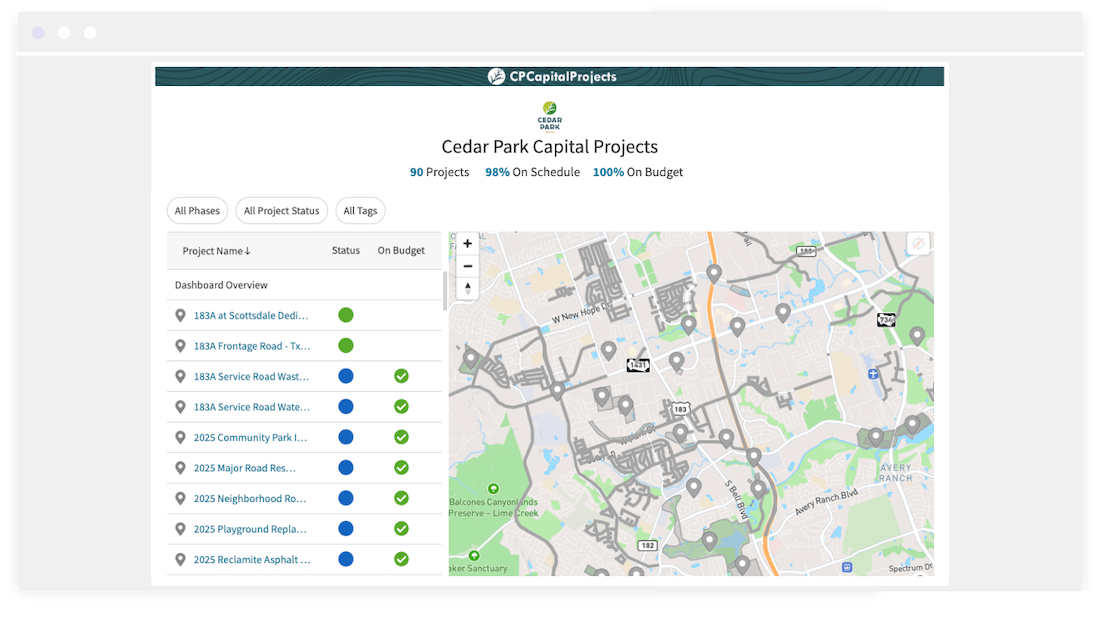
- You can track and share projects, budget, and status on a map-based dashboard (Great for community events, capital projects, housing projects, and other community-based initiatives.)
While both solutions boast some classic project management tools (Gantt charts, task management), ClearPoint’s project management capabilities are more typical of private sector project management needs and significantly more limited.
Enviso’s project management capabilities are – once again – integrated into your full strategic portfolio and can be fully linked into plans, reports, dashboards, and portfolio management tools across your organization.
“Envisio Projects has transformed how we communicate about our 89 capital projects spanning drainage, facilities, parks, transportation, wastewater, and water. The dashboard keeps our teams aligned and provides residents with an easy way to see where projects are happening, their status, and how they connect to our Strategic Goals.”
Ashley Smith, City Manager’s Office, City of Cedar Park, Texas
Reporting
Envisio and ClearPoint both have strong reporting capabilities. In both cases you can automate report creation, schedule delivery, customize the look, feel and format, and create different reports with different audiences.
The really significant differences here are around the native architecture of these two platforms for roll-up reporting across your organization.
Envisio was built to provide the ability to roll up KPIs and statuses from anywhere in the organization and report across as many planning elements as needed. With ClearPoint, every feature is scoped to a single scorecard, with some cross-linking capabilities.
If you are trying to get a single organization-wide view of your progress and performance, this is much more challenging to do in the ClearPoint platform – and almost always requires manual work.
An easy way to think about it:
ClearPoint is optimized for a single corporate strategy cascading down. Reports work cleanly within a single scorecard.
Envisio is optimized for multiple, parallel plans rolling up into organization-wide visibility. Reports work cleanly across the whole strategic portfolio.
In addition, Envisio’s reporting templates, best practices, and implementation processes are all built around the complex leadership dynamics of publicly funded, publicly accountable organizations specifically.
AI Features
Both Envisio and ClearPoint Strategy have invested heavily into AI capabilities within their platforms. However, there are differences in how the two companies have approached introducing AI functionality.
Which approach is more important to your organization today, is up to you.
Let’s walk through the different AI approaches.
Envisio’s focus, to date, has been around using AI to address some of the stickiest points of strategy and performance execution. We looked at the areas where AI could help organizations get unstuck, reach their goals faster, and more efficiently.
Here’s a simple, but powerful example: Envisio AI can look across all of your staff progress updates at different levels of your plan and summarize progress for roll-up reporting. This gives you executive summaries in minutes – something that used to take hours of reading and writing. These summaries are used in council packets, leadership meetings, and public-facing dashboards.
Another Envisio example would be the automatic creation of work plans based on your existing strategies and goals, and using analysis from across our public sector database.
Clearpoint has put their focus in this direction of auto-suggestions and analysis. An example would be their portfolio risk detection, which is interesting stuff.
In evaluating the two platforms, it’s worth asking the question around the extent to which data for your industry (gov, healthcare) can be parsed out for recommendations in ClearPoint, and the depth of their public sector data specifically. The ClearPoint database is big, but it is a mixture of public and private sector data. I don’t know the answer. It’s worth asking the question.
The bottom line here is that both companies are doing powerful and exciting things with AI today. This is one of the fastest moving areas of feature development, so you can expect to see more from both Envisio and ClearPoint as they innovate in this space.
Above all, our goal at Envisio is safe, secure AI that does not risk your data. Public sector work requires mature data governance, which is why it is baked into how we design, build, test and deploy new AI-driven functionality.
Dashboards
Envisio’s mission “to create trusted public agencies” has led us to do the research into what kind of transparency actually builds trust. You can learn more about our trust in local government research here.
Both Envisio and ClearPoint offer public facing dashboard features. There are differences in how they are set up and deployed.
Let’s start with the simple stuff:
Envisio dashboards can be published to any web page or embedded into your website. ClearPoint offers a single hosting model. All dashboards live on ClearPoint’s subdomain. There is no option to embed the dashboard into your own site (for example, your .gov domain) like you can with Envisio.
Both sets of dashboards are highly configurable. Envisio offers a number of “turnkey” dashboard templates that are ADA compliant and in line with our research. These dashboards can be customized to your organization, although we do provide guidelines in order to help you stay ADA compliant.
Envisio’s ADA compliance is native and audited by an independent auditor. ClearPoint’s accessibility is managed by a third-party overlay. More on accessibility in the “Other Considerations” section.
One of the biggest differences is what you can show on an Envisio dashboard versus a ClearPoint one. Envisio dashboards are built for storytelling to an external audience that may not be as mature in their organizational understanding as a set of private sector shareholders would be.
Envisio dashboards can include narrative updates, progress indicators, performance measures, scorecards, maps, or any combination of the above. They are rich in storytelling options, and we work with you to ensure you are informing and engaging your desired audience in order to build trust and reduce public enquiries.
Due to their foundations in scorecards, ClearPoint dashboards tend to be more operationally-based with fewer storytelling and contextual options.
The best way to see the types of dashboards being created with Envisio is to visit our inspiration gallery. The gallery covers strategic plans, climate action, affordable housing, public safety, economic development, capital projects, and more.
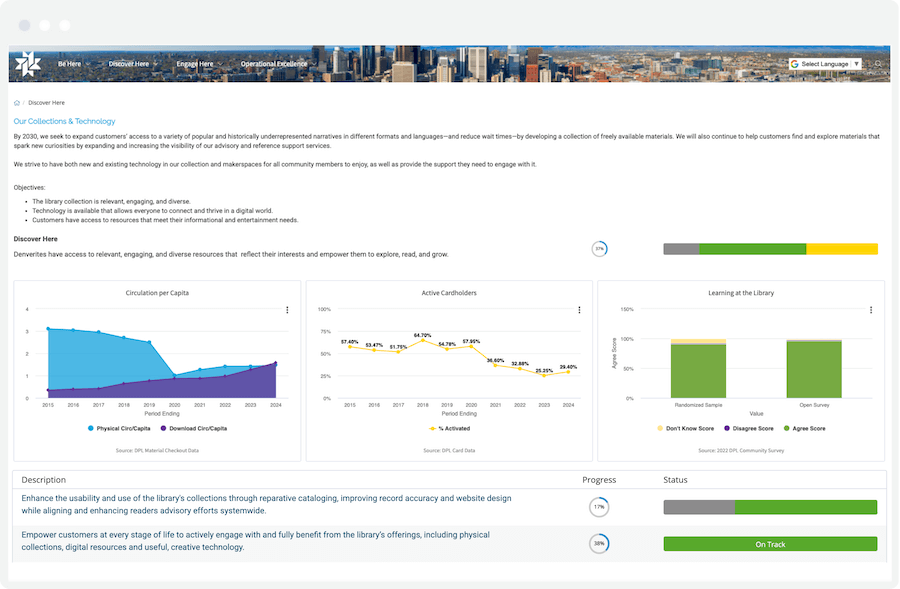
Screenshot of Denver Public Library’s Envisio dashboard, with staff updates, performance measures and progress indicators.
Integrations
Both Envisio and ClearPoint offer an open API. ClearPoint’s API is only available at the highest pricing tier, whereas Envisio’s is open to all customers. It is worth noting that ClearPoint’s API is permissioned and organized at the scorecard level. There are no endpoints for cross-scorecard aggregation, plan level roll-ups, or organization-wide data retrieval. If you are speaking to the Clearpoint team, I would strongly recommend learning more about how this affects your desired API use.
Many of ClearPoint’s integrations are offered through a middleware layer called Zapier. However, both companies do offer some native integrations.
Envisio focuses specifically on integrations with tools most commonly used in the public sector, including Power BI, Polco Track, and MS Teams. However, we are largely data agnostic, and can ingest and represent data from any platform that can push it out.
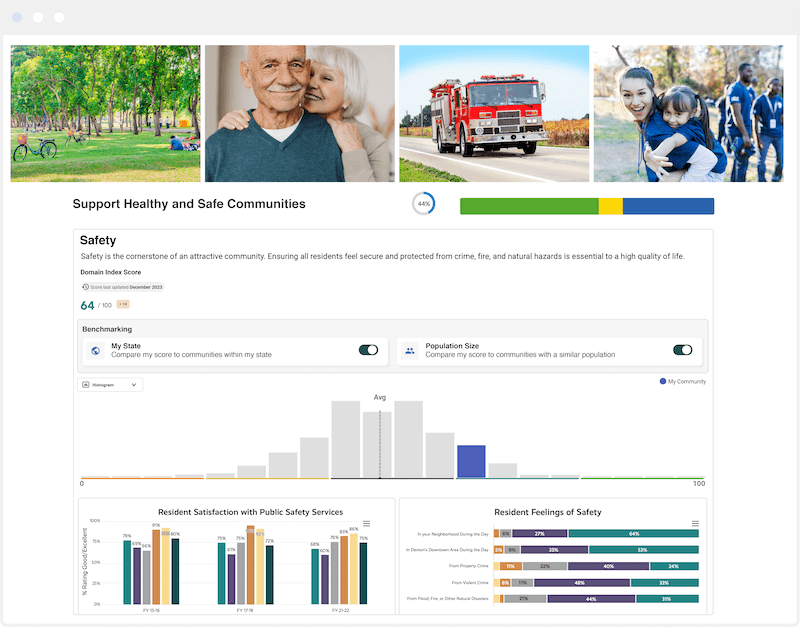
Envisio community dashboard including Polco Track livability data.
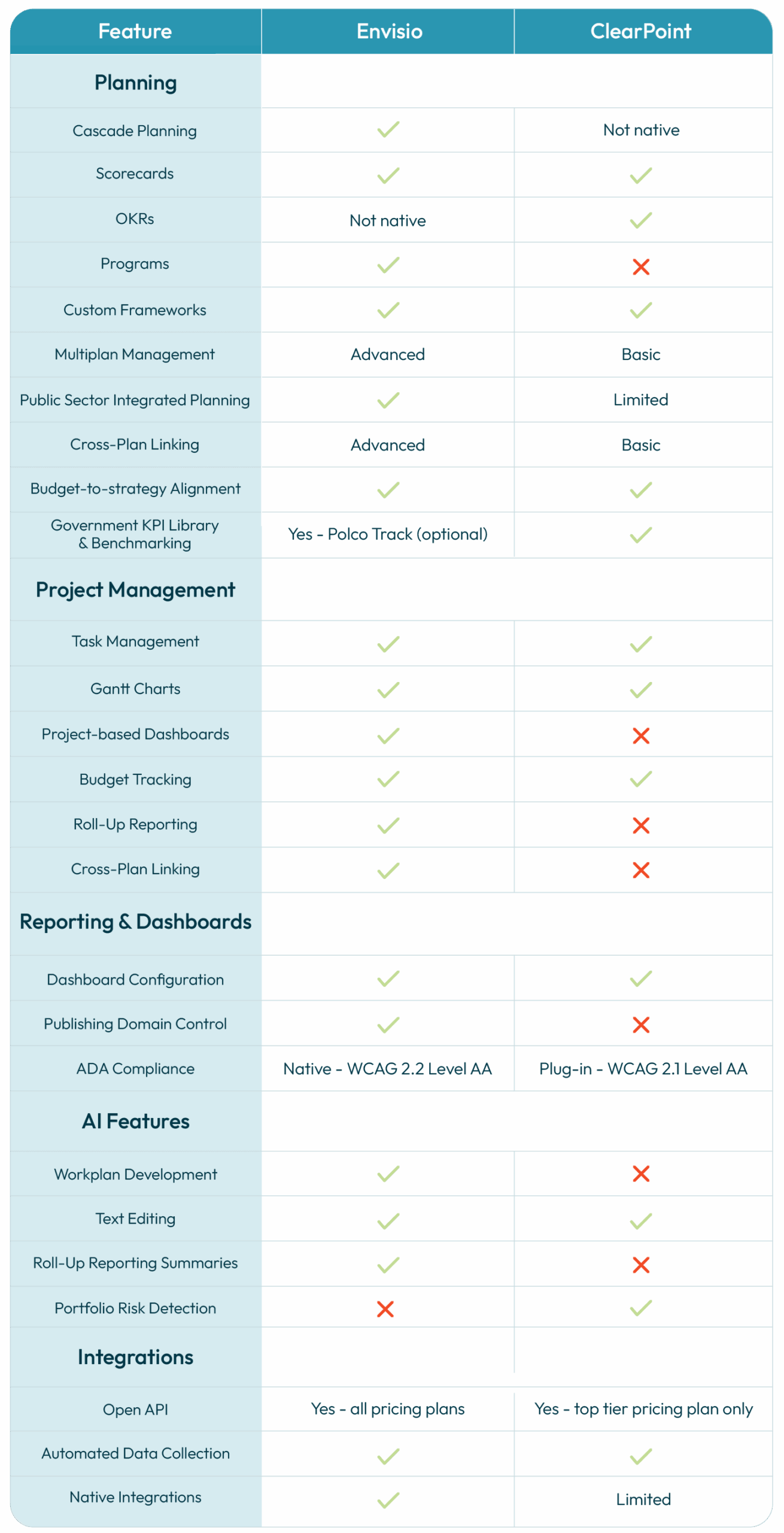
Envisio vs ClearPoint – Features
Here is how Envisio and ClearPoint stack up in terms of product features – with a focus on those relevant to public sector work.
Choosing a GovTech 100 Company
Envisio is proud to be recognized as a GovTech 100 company.
This means that we have been recognized as one of the top 100 companies working in North America driving innovation and impact for local and state governments.
When you work within Envisio, you know you’re working with a mission-based company focused exclusively on making an impact for cities, counties, towns, school districts, and other publicly funded, publicly accountable organizations.
Other Considerations
ADA Compliance
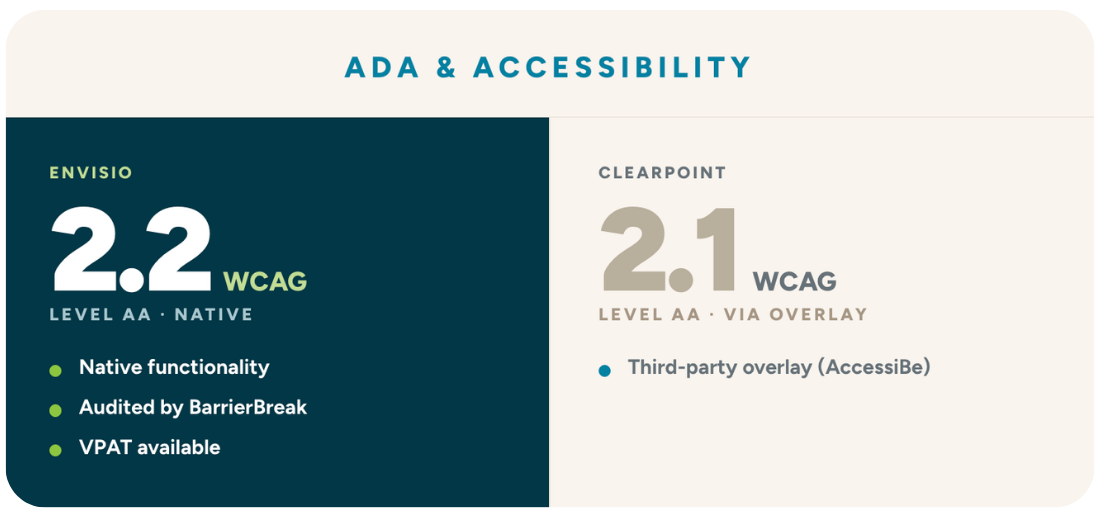
At Envisio, we take ADA compliance seriously. All Envisio public dashboards (whether plans-based, projects-based, or purely analytics) meet WCAG 2.2 Level AA standards and support ADA Title II obligations on both web and mobile.
While the current ADA Title II requirement is based on WCAG 2.1 AA, our public-facing dashboards are checked against the higher WCAG 2.2 standards. This ensures our software not only meets today’s legal requirements but is also prepared for future standards, providing a highly accessible experience for you and all your users.
Envisio works with a specialized auditor, BarrierBreak, to conduct our accessibility reviews. Envisio offers a Voluntary Product Accessibility Template (VPAT) so you can review the accessibility conformance of our products.
ClearPoint’s dashboard can also be made ADA compliant to WCAG 2.1 AA standard — but there is a caveat worth knowing: it’s delivered via an optional plug-in (AccessiBe) overlay, not built natively into the platform.
If your organization has strict procurement or accessibility audit requirements, a third-party overlay may not be sufficient.
I also feel duty-bound to make a personal plea not to use accessibility overlay tools if you can avoid it. At first glance, these tools seem like an easy and fast way to meet accessibility requirements. However, there is plenty of debate around the effectiveness of overlays – whether they actually provide a good experience for users with disabilities (or indeed, even protect you from lawsuits).
WeCo has an excellent blog on this: https://theweco.com/should-i-use-an-accessibility-overlay/
Pricing
Clearpoint and Envisio have different pricing models.
ClearPoint’s pricing is per-seat. Typically starts cheaper but gets more expensive than Envisio over time with additional users and more add-on services.
Envisio’s pricing includes unlimited users, unlimited projects, and unlimited reports so you can roll out Envisio across your organization without additional costs.
Data Hosting
Both Envisio and ClearPoint host customer data in the United States by default. However, Envisio also offers in-country hosting for Canadian and Australian public sector organizations.
Government Budgeting Recommendations
Envisio has been involved for a number of years in supporting the development and implementation of the new local government budgeting recommendations from the Government Finance Officers Association (GFOA) – based on the Rethinking Budgeting initiative. This new local government budgeting “operating system” was approved by the GFOA Executive Board in 2024.
Members of the Envisio team (including myself) were contributors to this final set of Rethinking Budgeting documents. Ensuring that we support these new budgeting recommendations is an area of continued focus and deep expertise for the Envisio team.
Final Note: Finding Your People
The work of public servants is uniquely complex. Social, economic, and political changes impact the public sector in a big way; from ever-growing budget constraints to changing regulatory requirements, to public accountability needs. These fast-changing demands and intricate dynamics often differ significantly from the challenges faced by private sector companies.
Our customer community is second to none. It includes some of the highest performing organizations in public sector work today, including many award-winners. We work from the smallest tribal governments to some of the largest counties and cities in North America to support them in reaching their goals.
Quick story: In April 2024, I was invited by the Alliance for Innovation to give a presentation to their Vision Council. This was a closed, invitation only session exploring some of the ways in which Envisio has built a trusted brand in such polarized times. The session was designed as an ideas exchange – to share private sector learnings that could be adopted in government.
Over the course of the session, I shared a few real examples of feedback I have received as a representative of the company over the years. Not to brag, but to highlight some of the trust traits we covered as a group during that session – integrity, openness etc – and how we hoped to live up to our mission and values as a team.
For this post, I went back and looked at some of the quotes. I wanted to share some of them here as a final love letter to the public servants who give themselves tirelessly to their work in making our communities better places to live.
“Your website spoke to my soul.”
“We chose Envisio because their values align with ours.”
“Envisio is more than a vendor; they’re family.”
“I really love the energy at Envisio.”
“I think I read EVERYTHING you guys post.”
“I cherish the relationships that we have built and I want to ensure that continues. All of you are amazing and inspiring individuals.”
Whichever platform you choose, we hope Envisio can continue to be a resource for you in your work.
Learn More
A great place to go next is to chat with our team. Book a demo and we’ll put you in touch with other organizations who switched from ClearPoint to Envisio.