Contents
- Project Management in the Context of Public Service
- 1. Visibility Has Become Central to Government Project Management
- 2. Greater Alignment With Strategic Goals and Budgets
- 3. Managing the Breadth of Government Project Management Work
- 4. Project Coordination Across Departments and Communities
- 5. Public Trust and Project Delivery
- Toward a More Visible Practice of Government Project Management
- Request a demo ↓
Summary
Government project management is changing as communities expect clearer communication, stronger accountability, and better alignment between plans, budgets, and real-world results. Local governments are shifting toward shared, transparent systems that make complex public work easier to manage and easier to understand.
This blog explores:
- Why visibility has become central to government project delivery
- How projects are being more tightly aligned to strategic goals and approved budgets
- How governments are managing complex, multi-department and regional project portfolios
- Why shared project dashboards improve coordination across teams and partners
- How public-facing project dashboards help build trust through clear timelines, budgets, and progress updates
With real-world examples from five local governments, the blog shows how modern project management practices are making public work more transparent, coordinated, and accountable—supporting better decisions and stronger public confidence.
Everything that gets done in local government is connected to something else; it’s just the way public service works.
Capital improvements move alongside long-range plans, and long-range plans move alongside budgetary constraints. Operational initiatives coexist with emergency responses. Policy commitments translate into projects that extend across years, multiple departments, and communities. This is the ecosystem of the public sector.
Government project management is a continuous activity shaped by overlapping timelines, funding cycles, leadership transitions, and public accountability. What has changed in recent years is the level of expectation around how that work is coordinated, tracked, and—importantly—communicated.
Project management is a core part of building trust in government. Residents increasingly want to understand what is happening in their neighborhoods and how public dollars are being used. Internally, government project management matters because elected officials and managers need clearer insight into progress, risk, and delivery timelines. Staff want approaches that reflect how public work actually happens, rather than forcing it into rigid, abstract, or private-sector frameworks.
In response, many local governments are rethinking how major projects are managed. The goal is to better connect planning, day-to-day work, budgets, and public updates. Dedicated public-sector project dashboards and government project management software are becoming common ways for cities, counties, and regional governments to track progress and explain what’s happening.
Project Management in the Context of Public Service
Government projects are typically funded through public budgets, approved through formal (and often complex) decision-making processes, and delivered in ways residents, community groups, and partner organizations can see and experience. Sidewalk repairs, water system upgrades, park improvements, transportation corridors, and housing projects all shape daily life in a community.
Capital programs are a clear example. Capital Improvement Plans (CIPs) connect long-term priorities to near-term work by translating policy decisions into multi-year investments. These projects often involve significant funding, multiple phases, and assets designed to serve the community over long periods of time.
Many governments are responding by improving the structure and consistency of their project management practices. When project information is organized, kept up to date, and shared reliably, it strengthens internal coordination and improves communication with the community.
Envisio Projects has transformed how we communicate about our 89 capital projects spanning drainage, facilities, parks, transportation, wastewater, and water […] It’s helping us showcase that 94% of projects are on schedule, and 100% are on budget while ensuring transparency and collaboration well into the future. – Ashley Smith, Cedar Park
Here are five ways we’re seeing government approaches to project management change—and what we like about the trends emerging.
1. Visibility Has Become Central to Government Project Management
One of the most notable changes over the past decade has been the growing emphasis on visibility in government project management. This doesn’t mean exposing every internal task or decision. Instead, it means presenting accurate, current information about project status, funding, and milestones in a way that is reliable and easy to understand.
Public dashboards play an important role in this approach—especially when they’re directly connected to the systems staff use to manage their work. When project updates are part of everyday workflows rather than a separate reporting exercise, information stays current without adding administrative burden.
Many of these dashboards are powered by government project management software that connects project tracking directly to planning, budgeting, and reporting workflows.
Example 1: Borough of State College — Structuring Capital Projects for Public Understanding
The Borough of State College’s Capital Improvement Plan Learning Center offers a strong example of how to organize, explain, and communicate capital projects clearly.
The borough has embedded its projects dashboard directly into its website, allowing residents to explore the five-year capital improvement plan and understand the criteria used for inclusion: projects valued at $100,000 or more with an expected lifespan of six years or longer.
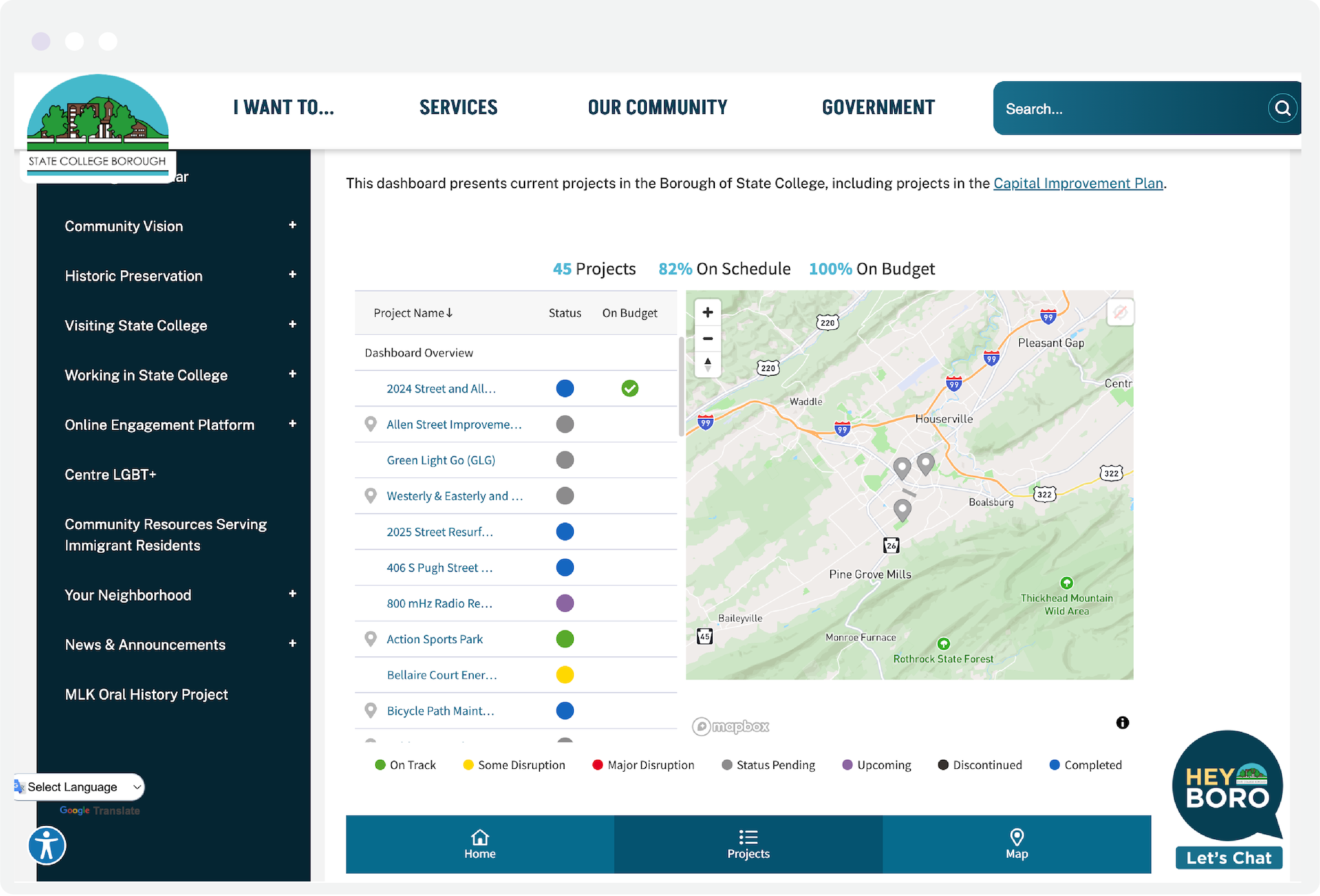
This structure reflects an important shift in government project management: treating capital planning as an ongoing, publicly accessible process rather than a static CIP document. By clearly defining what qualifies as a capital project and grouping projects by type, the borough gives residents a framework for understanding how investments are prioritized and managed.
From a project management perspective, this approach supports consistency and transparency. Projects are grounded in defined criteria, tracked over a multi-year horizon, and presented in ways that connect financial commitment to physical outcomes. For staff, it reinforces alignment between budgeting and execution. For the public, it provides clarity about what is included in the CIP and why.
2. Greater Alignment With Strategic Goals and Budgets
Keeping plans and projects aligned is an ongoing challenge in local government. Long-term plans, such as strategic plans, set direction; project management is where that direction is carried out.
Effective government project management demonstrates alignment in four key ways:
- Connecting projects back to strategic goals, where relevant
- Aligning capital programs with plan priorities
- Reporting progress in ways that show how project work supports broader outcomes
- Clearly showing the connection between project work and budget allocation
This type of alignment gives cross-functional teams clearer direction, provides leadership with better visibility into resources, and gives the public clearer context for why projects move forward.
Example 2: City of High Point — Aligning Projects With Plans and Funding
The City of High Point’s Strategic Project Dashboard shows how detailed project tracking can reinforce alignment between plans, budgets, and execution.
For example, the BUILD Grant project dashboard connects scope, timeline, and funding in one place, making it easier to see how a major capital project is progressing against approved commitments.
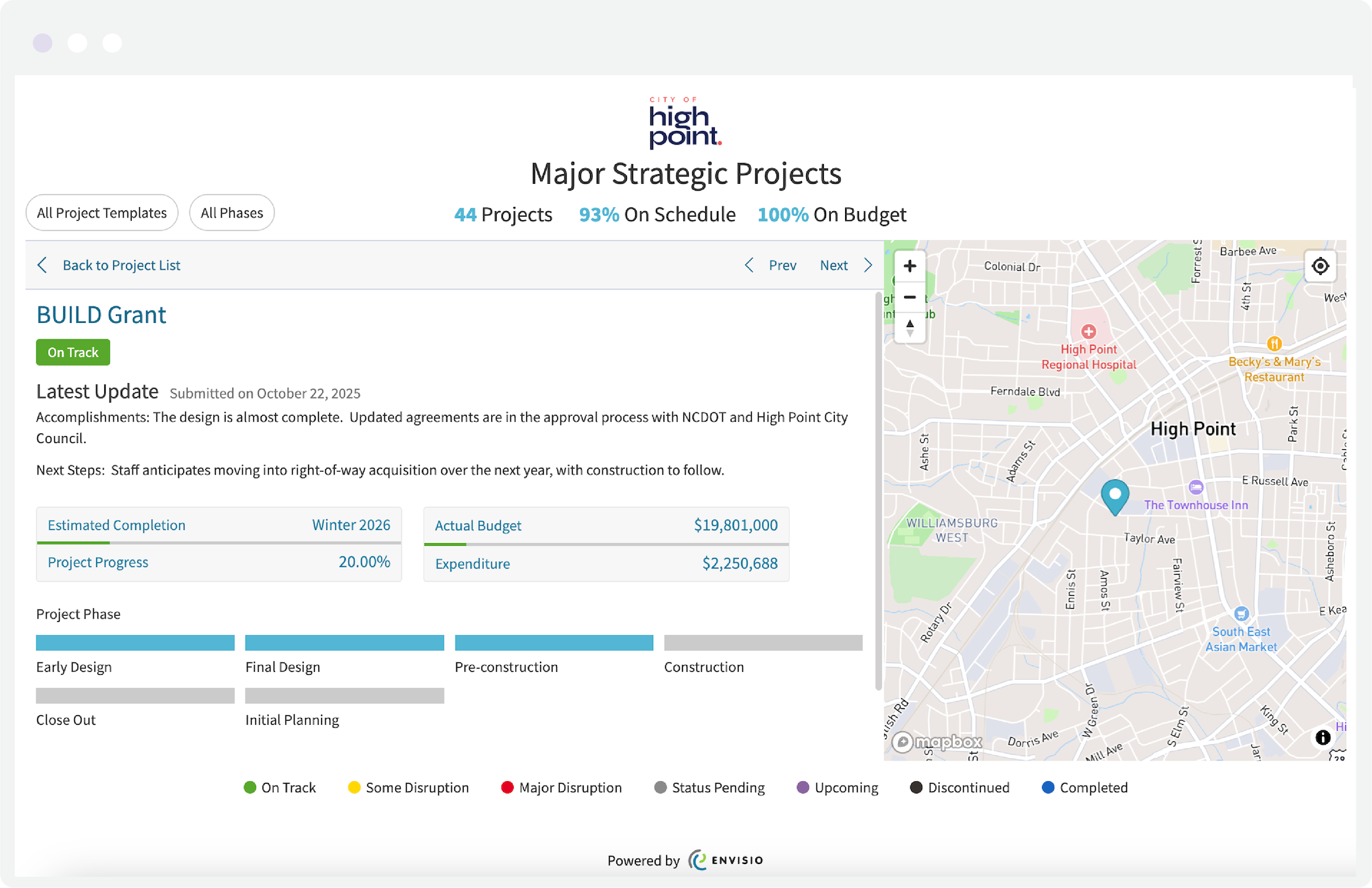
Each project update includes the current phase, percent complete, estimated completion date, total budget, and expenditures to date. Narrative updates document progress through the phases of design, approvals, and upcoming right-of-way acquisition, linking day-to-day activity back to planned milestones and funding assumptions.
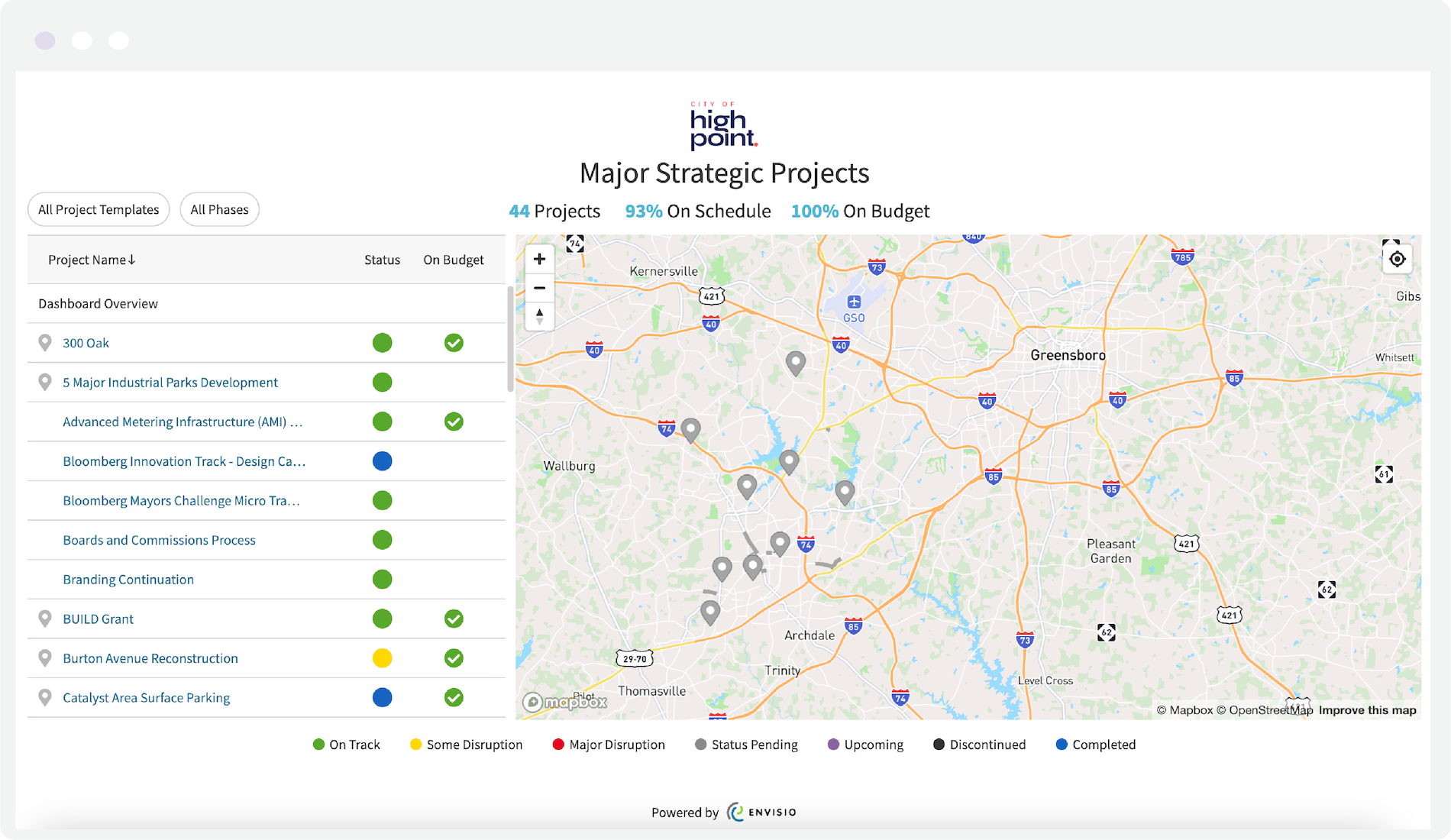
Their Strategic Project Dashboard also clearly shows whether a project is within budget. When financials, project phases, and next steps are tracked together, staff and leadership can better assess whether work is advancing as planned and when adjustments are needed. For the public, this provides context for how capital funding is being used and how progress relates to longer-term infrastructure goals.
3. Managing the Breadth of Government Project Management Work
Government project management spans a wide range of work types, many of which operate continuously rather than as one-time initiatives. Capital improvements are only one category.
Internal operations, regulatory updates, technology implementations, public safety initiatives, environmental programs, and community services all depend on coordinated project management.
What’s working for local governments in this context isn’t adherence to a single methodology, but the ability to manage complexity without obscuring it. Effective government project management allows projects to adapt to changing conditions while staying anchored to approved scope, budgets, and purpose.
Dashboards that reflect real project phases—planning, design, pre-construction, construction, and close-out—help communicate this complexity honestly. They also support more informed internal discussions about sequencing, dependencies, capacity, and risk.
Example 3: Barcaldine Regional Council — Managing a Wide Range of Projects
Barcaldine Regional Council’s Capital Works Program dashboard shows how government project management can support a diverse mix of projects without sacrificing clarity. The dashboard brings together work across multiple communities—Aramac, Barcaldine, Jericho, and Muttaburra—into a single, easy-to-navigate view.
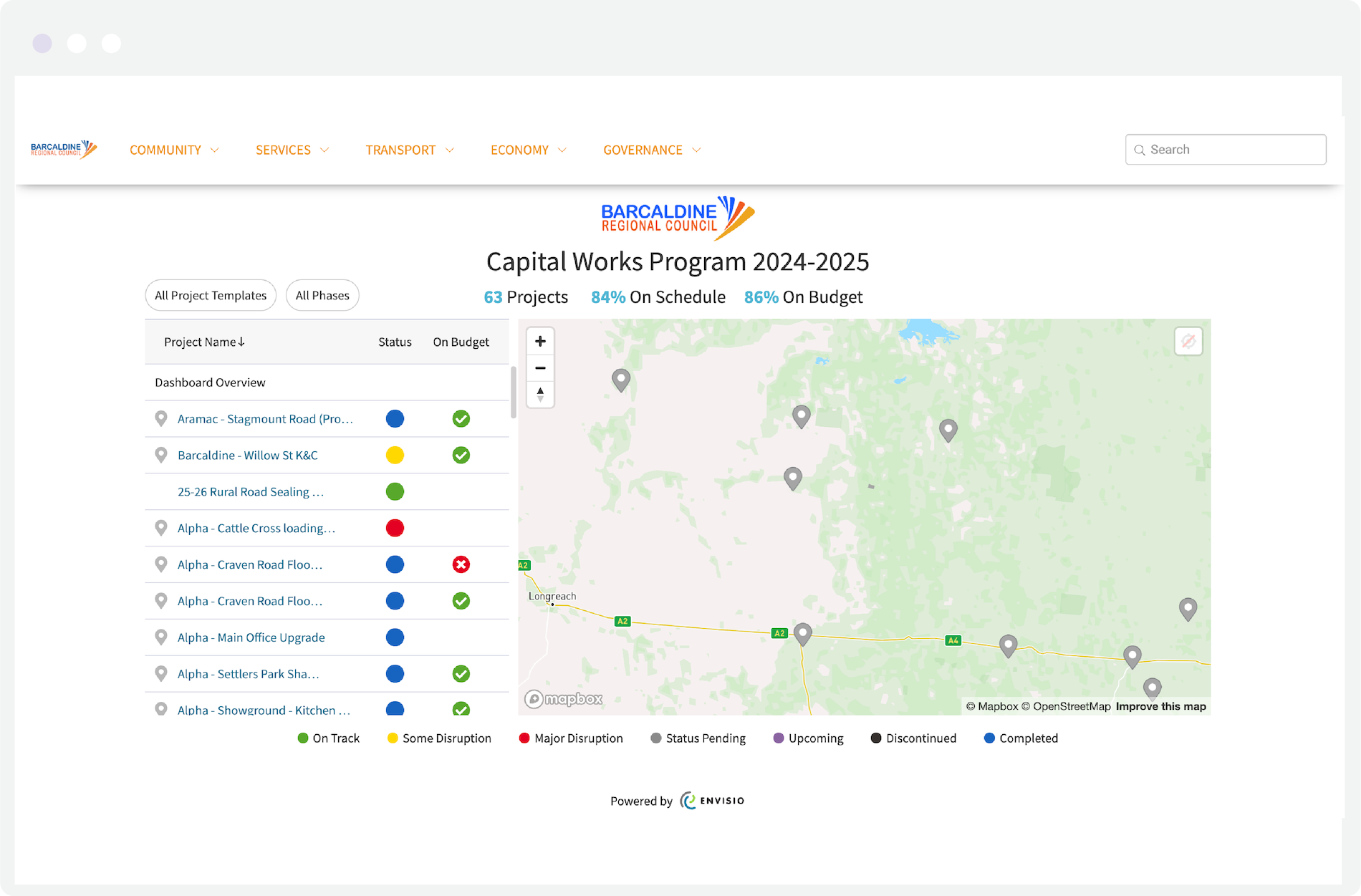
Projects included on the dashboard can be explored by location, with clear details on:
- Budget
- Project phase
- Expected completion
This structure reflects the reality of government work, where infrastructure upgrades, maintenance programs, and community projects often run at the same time.
Because the dashboard draws directly from the council’s internal project management system and is updated monthly, it provides a consistent view of progress across the entire capital program. Staff can manage many projects at once, leadership can see how work is distributed across the region, and residents can follow what’s happening in their community.
By bringing a diverse set of projects into one place, Barcaldine demonstrates how thoughtful government project management can handle scale and variety while keeping information clear and usable.
4. Project Coordination Across Departments and Communities
Local government work often spans multiple departments and, increasingly, multiple organizations. Transportation projects intersect with utilities. Housing initiatives involve planning, finance, and community services.
Capital programs depend on coordination among engineering, procurement, communications, and executive leadership.
Government project management approaches that emphasize shared visibility help this work stay aligned. When teams can see how their efforts connect—and how timelines and dependencies intersect—projects move forward with greater clarity and fewer disruptions.
This approach is especially valuable for central offices responsible for reporting to elected boards and the public. A consolidated view of projects across departments offers a clearer picture of workload, capacity, and progress than disconnected tools can provide.
More governments are now extending this shared view beyond municipal departments to include partners such as regional agencies, community organizations, and other levels of government. Treating project management as shared infrastructure supports coordination across teams and strengthens connections between departments, partners, and the communities they serve.
Example 4: Sioux Lookout, Ontario — Project Management That Supports Collaboration
An emerging trend in government project management is using shared project views to support collaboration across departments and with community partners.
The Municipality of Sioux Lookout’s Community Compass dashboard reflects this approach. Projects are organized around strategic focus areas such as Community Innovation & Development and Regional Collaboration, providing a clear picture of how infrastructure projects, community programs, and partnership-driven initiatives connect to long-term goals.
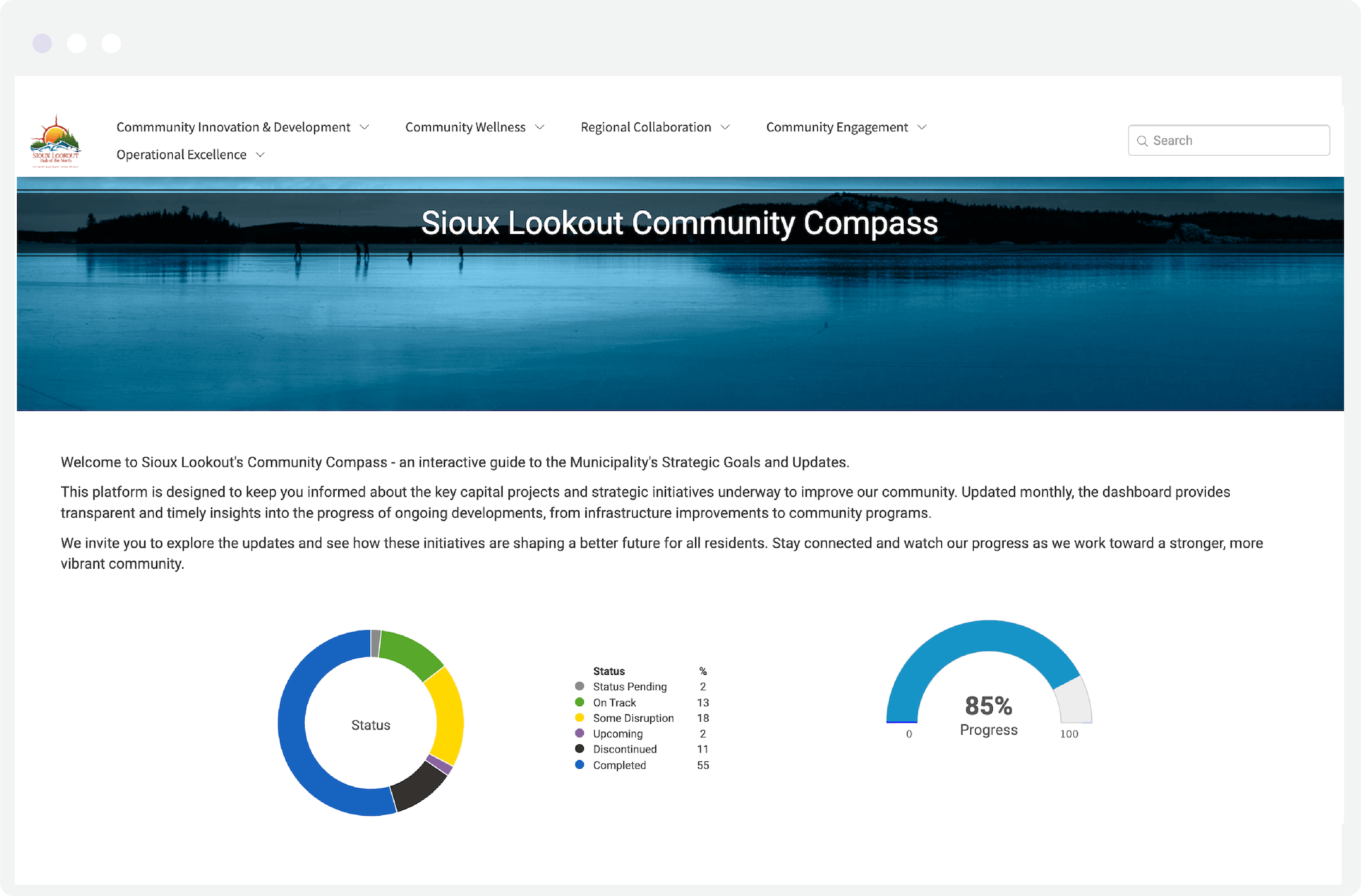
Updates focus on concrete progress: Infrastructure planning, housing strategy work, economic development initiatives, and environmental projects are tracked alongside public engagement and implementation steps.
5. Public Trust and Project Delivery
Trust in government is built over time through consistent, accurate communication. Government project management practices that prioritize accuracy and openness help set realistic expectations and support long-term credibility.
When residents can see that timelines are updated, budgets are tracked, and challenges are acknowledged, confidence grows—even when projects experience delays or changes. Clear indicators of progress, defined phases, and narrative updates about accomplishments and next steps provide a fuller picture than status labels alone.
Example 5: Town of Northlake, Texas — Building Public Trust Through Clear Project Updates
The Town of Northlake, Texas demonstrates how transparent project tracking can strengthen public trust in government project delivery. Through its public projects dashboard, Northlake shares up-to-date information on 17 active capital and infrastructure projects, with clear indicators showing that 88% are on schedule and 87% are on budget.
The dashboard is built on Envisio’s government project management software designed specifically for public sector planning and capital project tracking.
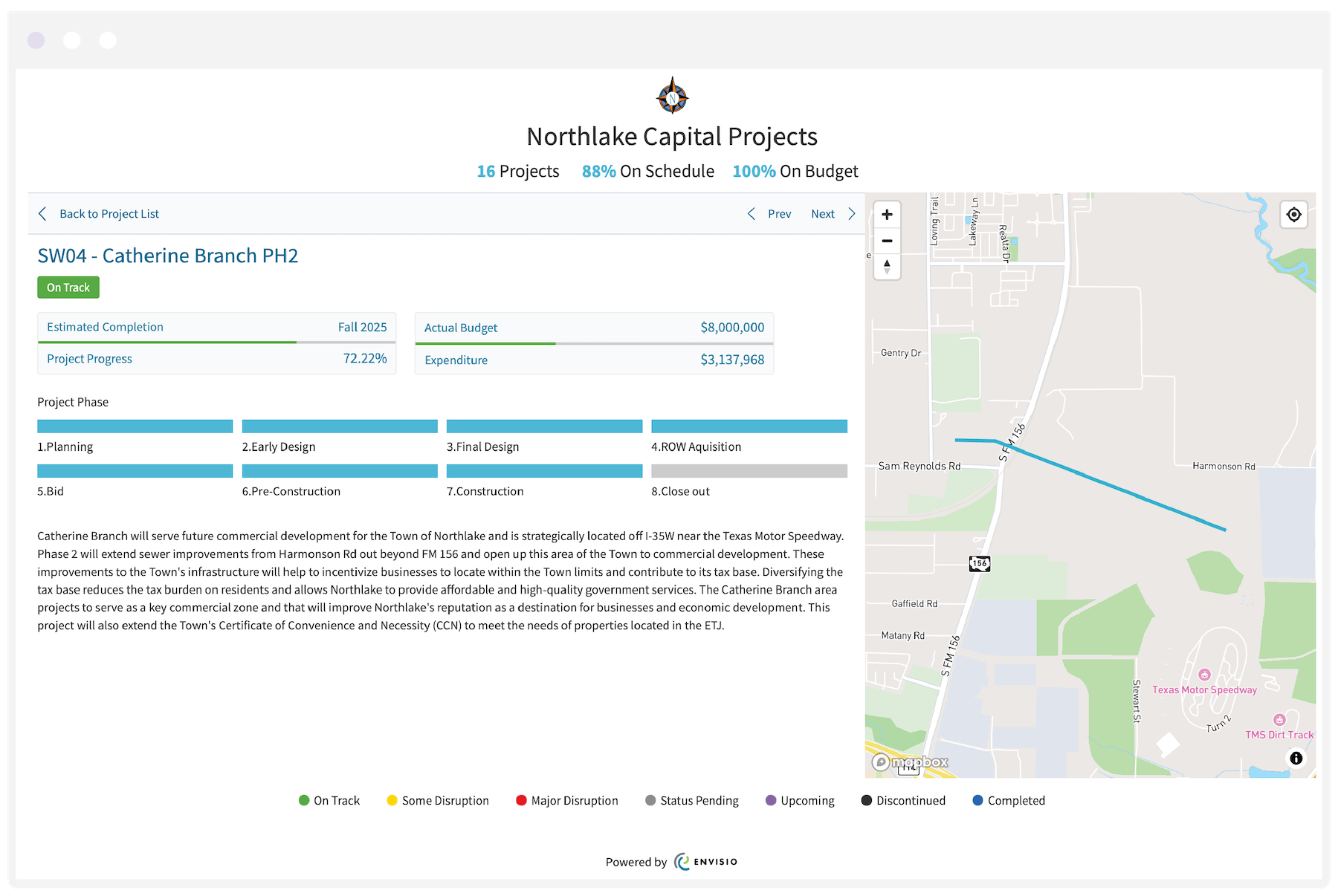
The City of Northlake, Texas uses Envisio Projects to display its Catherine Branch infrastructure upgrades, tracking 16 public works projects in one place.
Here’s how Northlake makes building public trust easier:
-
Sharing full project scope and current phase
Each project shows what the work includes and which phase it’s in, from planning and design through construction and close-out. -
Displaying budgets and expenditures to date
Total project budgets and current spending are visible in one place. -
Tracking progress with clear completion percentages
“Percent complete” indicators show how far work has advanced. -
Including plain-language project updates
Narrative descriptions explain the purpose of each project and how it supports community needs. -
Showing estimated completion timelines
Target completion seasons and years help set realistic expectations.
Why does this matter?
Clear, current project information helps residents understand what’s happening in their community, how public dollars are being used, and what to expect as work moves forward. This transparency goes a long way in supporting confidence in local government project delivery.
By combining current status, financial data, timelines, and explanatory updates in one place, Northlake offers a practical model of government project management that supports informed expectations, accountability, and long-term public confidence.
Toward a More Visible Practice of Government Project Management
What’s working for government organizations today reflects a more integrated approach to large-scale project management:
- Projects are more visibly connected to plans, desired outcomes, and budgets.
- Information is increasingly maintained in shared systems.
- Public dashboards tell a story by providing context, not just isolated data points.
As more governments adopt these practices, the focus continues to shift from simply tracking activity to supporting shared understanding and more informed decision-making. This shift reflects a deeper commitment to making public work visible, coordinated, and trustworthy—one project at a time.
Request a demo ↓
Ready to strengthen government project management across planning, budgeting, and delivery? Envisio helps local governments track projects clearly, coordinate work across departments, and communicate progress with confidence through public dashboards and real-time reporting. Request a free demo to see how Envisio supports transparent, accountable project delivery.