
Summary
Climate action planning is one of the most urgent challenges facing communities today. This blog explores why local governments play a critical role in turning global climate commitments into measurable, on-the-ground action.
Drawing on real-world examples from cities across North America, the post highlights what makes climate action plans effective, achievable, and accountable.
- Local governments are uniquely positioned to address climate change—large enough to drive systemic change, yet close enough to respond to local needs and vulnerabilities.
- Strong climate action plans combine clear goals with practical focus areas, including natural asset management, data-driven decision-making, green infrastructure, leadership buy-in, and resilience.
- Public dashboards and performance tracking help translate ambitious climate goals into measurable initiatives, while making progress visible to residents and decision-makers.
- Cities like Port Moody, Edina, Denton, West Hollywood, Richfield, and Rockville show how climate plans can align mitigation, adaptation, equity, and economic sustainability.
- When climate action is championed by leadership and embedded into everyday planning and reporting, plans are more likely to deliver sustained, real-world impact.
By grounding climate action in data, transparency, and local leadership, municipalities can move beyond rhetoric and put hope into action—building more resilient, equitable communities in the face of a changing climate.
Climate action planning—and taking the reality of climate change seriously—is one of the most pressing existential issues of our time. The impacts are already being felt around the world, from extreme weather events like hurricanes, floods, and wildfires to the loss of critical ecosystems such as coral reefs and rainforests. These changes don’t just affect natural systems; they also strain social and economic systems, exacerbating poverty, food insecurity, and global inequality.
The Paris Agreement requires that we globally limit global warming to no more than 1.5°C above pre-industrial levels. Failure to do so could trigger irreversible and catastrophic changes, such as the collapse of major ice sheets, the loss of entire species, new diseases and viral threats, severely compromised air quality, and the displacement of millions of people due to sea-level rise, and other climate impacts.
Local governments are not typically included at the major national climate summit tables, but their role is central.
Cities are responsible for most global emissions, and they are often the first responders to climate impacts like flooding, extreme heat, and wildfires. Municipal climate action plans show how goals translate into measurable work on the ground. They also provide examples of policies and practices that national governments can learn from as they finalize their own NDCs.
Local Governments and Climate Action Planning
Oftentimes, the rhetoric around climate change can over-emphasize one individual’s impact and de-emphasize the things that can really make a difference. Local governments, however, are the perfect in-between: large enough to make systemic change, and small enough to engage individuals. Cities have an ability to respond to climate change in a way that is localized to their region, their economy, and their capacity.
Cities are responsible for a significant proportion of global greenhouse gas emissions. According to the United Nations Environment Programme, cities and urban areas account for an estimated 75% of global energy-related emissions, with transportation and building developments being the largest contributors.
A city embracing or creating a climate action plan as either a strategic pillar in a broader plan or as an overall strategic city goal can make progress seem possible where it would otherwise be impossible.
Climate action planning matters because they are precisely the antidote to hopelessness. There are significantly impactful changes that need to be made, and that can be made, by local and municipal governments.
So what makes a strong climate action plan?
We work closely with hundreds of innovative local governments, and we take our cue from their careful actions. The trends that are most consistent and that best represent achievable, time-measured, and specific goals focus on:
- Managing and taking care of natural assets
- Leveraging data to support climate action
- Embracing green infrastructure
- Financing sustainability and leadership buy-in
- Adaptability and resilience
From our analysis of our customers’ climate action plans, we believe the above features are what make a strong climate action plan that is comprehensive, socially equitable, and achievable, and one that addresses both the causes and impacts of climate change.
Managing and Taking Care of Natural Assets
Strong climate action plans address both engineered and natural infrastructure. Cities often account for roads, pipes, and buildings in their asset management systems, while forests, wetlands, and waterways are left out of the calculation. Yet natural assets provide services that are essential for municipal operations, from storing carbon to controlling rainwater runoff.
When these systems are valued and managed properly, local governments can avoid costly engineered replacements and reduce financial risk.
Tracking natural assets through performance dashboards gives decision-makers and residents a clear picture of the value these ecosystems provide. It also makes trade-offs in planning and development easier to evaluate. Cities that treat natural assets as infrastructure show a model other communities can follow.
Climate Action Plan Example 1: The City of Port Moody, BC
Port Moody has become a leader in natural asset management, embedding it directly into the city’s climate action framework. With the help of strategic execution software, their latest public dashboard tracks progress on protecting and enhancing waterways, strengthening the urban forest, and planning for extreme weather and sea-level rise. These priorities are supported by the Natural Asset Management (NAM) Plan, a policy endorsed unanimously by council in early 2025.
The NAM strategy places natural assets—trees, marshes, streams, lakes, and wetlands—on equal footing with engineered infrastructure.
An inventory has been created with services valued at approximately $377 million, including erosion prevention, carbon storage, watercourse drainage, and stormwater management. The policy integrates these assets into the city’s overall asset management system, ensuring that decisions about land use, infrastructure, and development take both financial and ecological services into account.
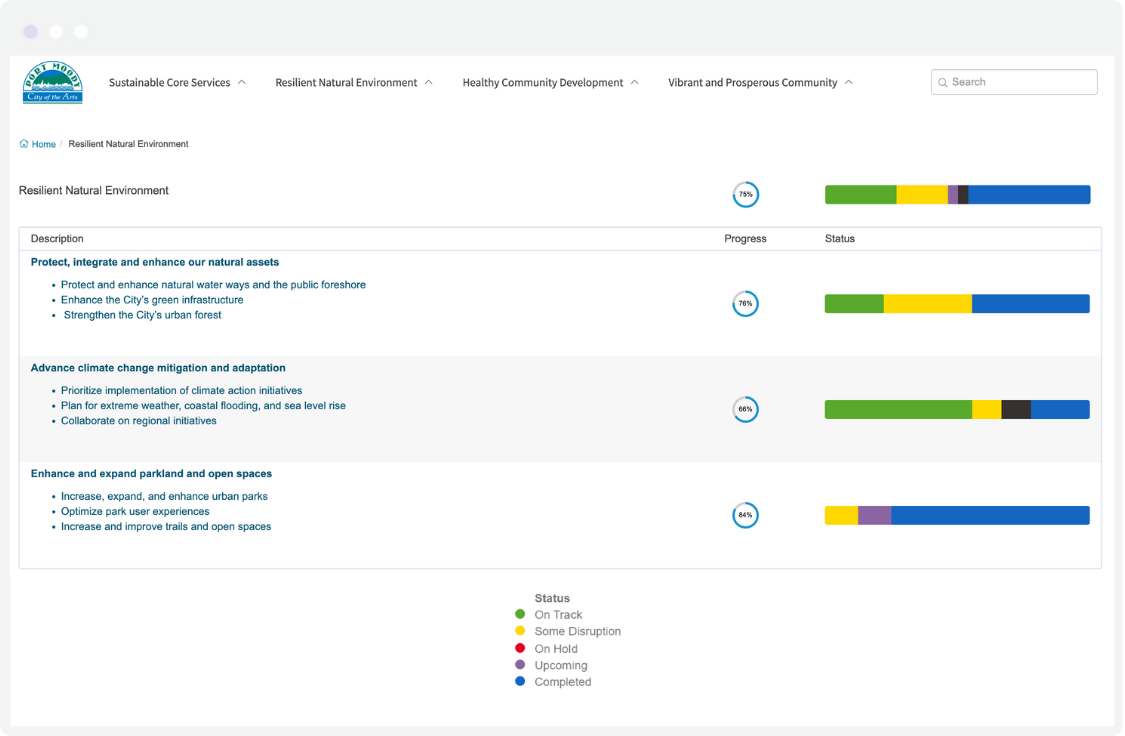
Council discussions now weigh the trade-offs between carbon sequestration, stormwater retention, and other ecosystem services alongside climate mitigation and adaptation priorities—like planning for extreme weather, coastal flooding, and sea level rise.
Port Moody’s example also shows how municipalities can make climate action plans more actionable by translating big goals into measurable initiatives—regional collaboration (like the Tri-Cities Climate Mobility Strategy, now 100% Completed), building decarbonization (the BC Energy Step Code Acceleration, 100% Completed), and practical infrastructure upgrades (like the Streetlight LED Replacement Program.
See Envisio in Action
See why public sector teams choose Envisio to plan, track, and report on what matters.
- Centralize performance data
- Automate progress reports
- Publish dashboards for the public
Leveraging Data to Support Climate Action
Collecting accurate data on climate impacts is essential for local governments. It helps them understand risks and respond effectively. A strong climate action plan starts by identifying gaps in current efforts and areas of vulnerability—from which populations face the greatest risk, to where the community contributes most to pollution, greenhouse gas emissions, and non-biodegradable waste.
Climate Action Plan Example 2: The City of Edina, MN
One of our customers, The City of Edina, collected data on eight different climate areas:
- Transportation and land use
- Buildings and energy
- Waste management
- Water and wastewater
- Local food and agriculture
- Greenspace and trees
- Climate health and safety
- Climate economy
From Long-Term Goals to On-the-Ground Work
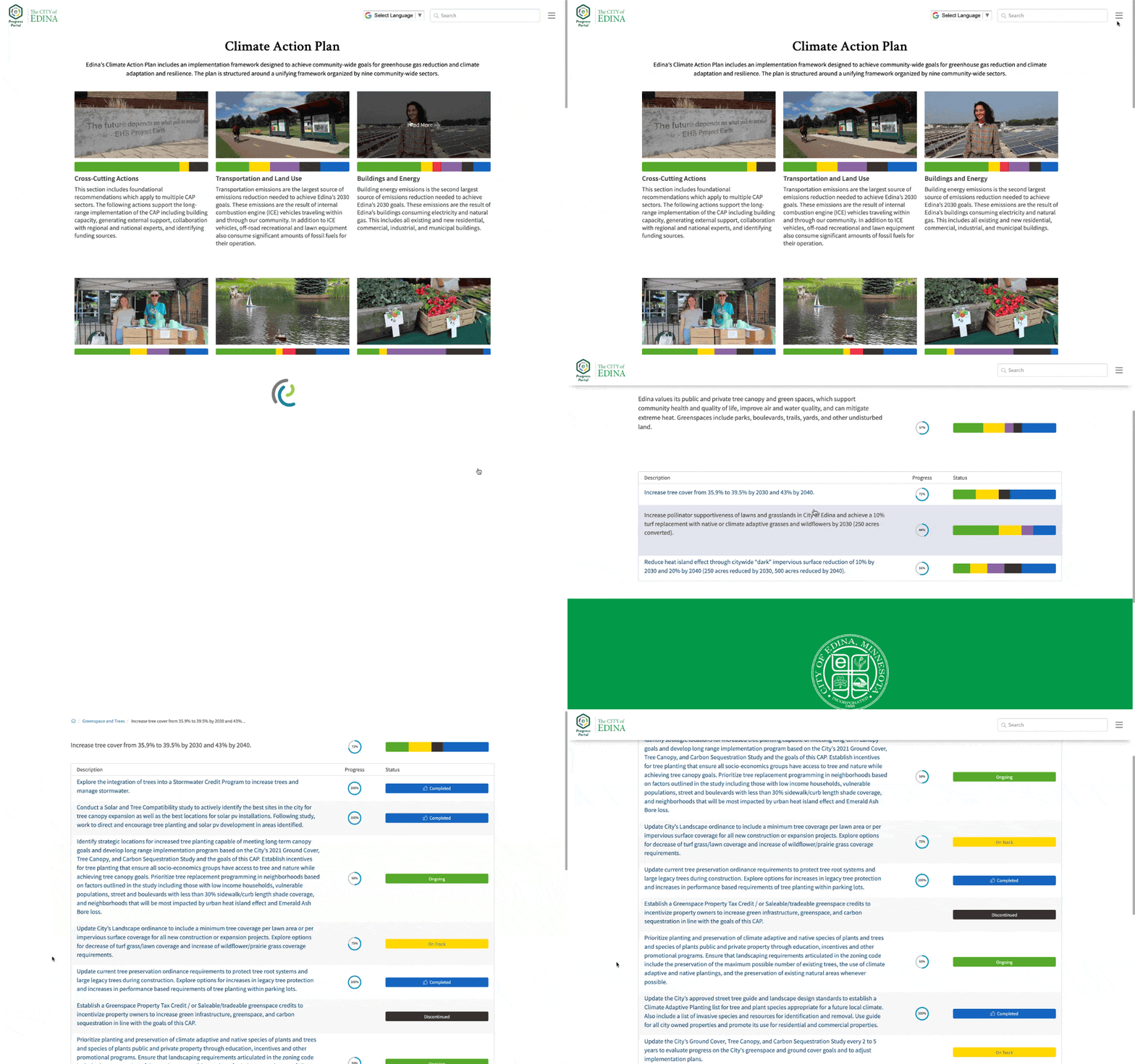
Edina’s updated climate action dashboard makes it easier to see how long-term climate goals are turning into on-the-ground work. In particular, the dashboard highlights the City’s focus on expanding tree canopy and reducing the urban heat island effect—two areas where Edina is treating natural assets as essential infrastructure.
Trees and green spaces play a central role in Edina’s climate strategy. They support community health, improve air and water quality, and help reduce extreme heat.
Focused Goals for Canopy and Heat Mitigation
The dashboard clearly lays out where the City is headed, with defined canopy targets to increase tree cover from 35.9% today to 39.5% by 2030 and 43% by 2040, alongside regular progress updates on the initiatives supporting those goals.
Because this work is tracked in one place, it’s easier to see how planning connects to implementation. Edina has already identified priority locations for long-term tree planting through its Ground Cover, Tree Canopy, and Carbon Sequestration Study.
Ongoing initiatives—such as equity-focused planting incentives, updates to landscape and tree preservation ordinances, and protections for legacy trees during construction—show how those insights are being turned into policy and action.
Quantifying Heat Mitigation and Canopy Targets
The dashboard also ties tree canopy expansion directly to heat mitigation. Edina is tracking progress toward reducing dark, heat-absorbing impervious surfaces citywide, with targets of a 10% reduction by 2030 and 20% by 2040. Completed green roof, green wall, cool roof, and cool pavement pilot projects demonstrate how these strategies can work in practice, with an emphasis on locations most affected by heat and areas serving vulnerable populations.
Data-Driven Vulnerability Mapping
Because they were so rigorous in their data collection, they were able to identify areas of vulnerability. Having accurate data helps local governments identify areas that are most vulnerable to the impacts of climate change, such as sea-level rise, flooding, or extreme heat. For example, The City of Edina was able to identify 1,437 properties at risk of flooding, in their climate health and safety section. This information can be used to prioritize and target resources towards those areas.
Leadership Championing Climate Action Setting the Tone
Climate action plans don’t move forward on their own. Lasting progress starts when local government leadership makes a clear choice to prioritize climate action—and consistently reinforces that priority through policy, funding decisions, and public accountability.
When councils and senior staff set the tone, climate action becomes part of how a city plans, delivers services, and measures success.
Climate Action Plan Example 3: The City of Denton, TX
The City of Denton offers a strong example of what it looks like when climate leadership is embedded at the highest level. In 2022, City Council passed Ordinance 22-746, committing Denton to science-based targets to significantly reduce community-wide greenhouse gas emissions and reach net-zero by 2050. That commitment didn’t stop at a resolution—it triggered the development of Denton’s first formal Climate Action Plan, which Council adopted in August 2024.
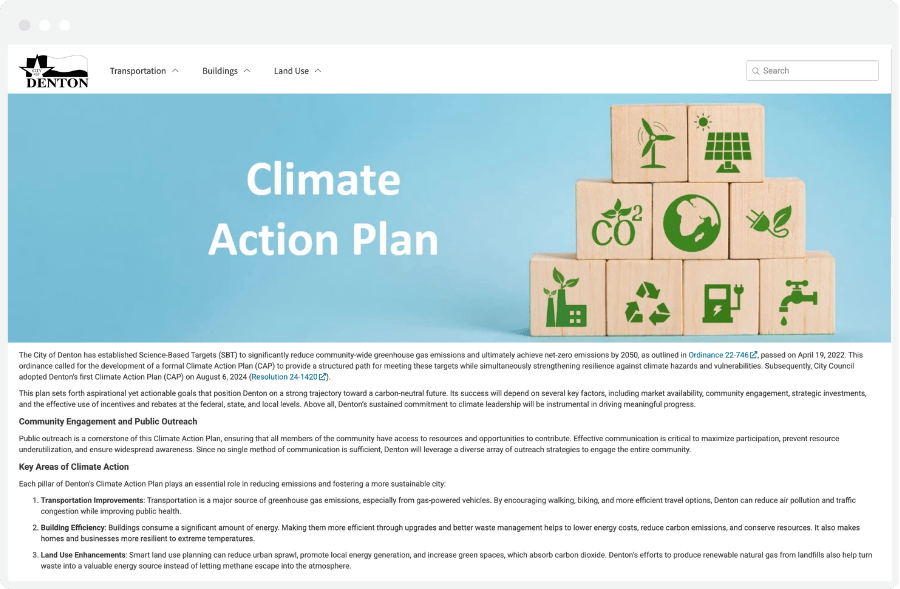
Denton’s Climate Action Plan sets out ambitious but practical goals—and, just as importantly, makes progress visible. By launching a public-facing climate action dashboard, the City is signaling that climate commitments are not aspirational statements, but work that will be tracked, updated, and reported on over time.
Key areas of action reflect where leadership has chosen to focus:
- Transportation: Reducing emissions by improving active transportation options, encouraging walking and biking, and making travel more efficient overall.
- Buildings: Advancing energy efficiency, reducing waste, and strengthening resilience to extreme temperatures through both new construction standards and upgrades to existing buildings.
- Land use: Expanding renewable energy generation, improving access to daily necessities, and turning waste streams—like landfill organics—into renewable natural gas.
Implementation in Action: The Pecan Creek Pilot
That leadership shows up in implementation, too. Denton is piloting organics management initiatives at its Pecan Creek Water Reclamation Plant, including commercial composting and co-digestion pilots, downtown source-separated organics collection, and expanded food waste diversion for large generators like schools. These projects are tracked openly, with clear status updates that help maintain momentum and accountability.
By formally adopting science-based targets, aligning departments around shared goals, and committing to transparent reporting through a public dashboard, Denton has made climate action part of its organizational culture.
It’s a reminder that when local governments choose to champion climate action from the top, plans are more likely to translate into measurable, sustained progress.
Get the Operational Planning Guide
Turn your strategic plan into clear, measurable progress.
- Create SMART, measurable actions
- Align plans with budget & capital projects
- Report progress that builds public trust
Promoting Climate Action Economic Sustainability
Balancing ambition and economic feasibility is another key element of a strong climate action plan. Decarbonizing the economy—transitioning to a low-carbon based energy economy—can be perceived as a high-risk economic activity. The problem is, climate change is already accounting for huge portions of economic devastation. Climate action failure is listed by the World Economic Forum as the most impactful long-term risk facing the world. Based on this assessment, the pros of making the changes vastly outweigh the cons. And sometimes, you just need a leader to take the plunge, in order to demonstrate the benefits.
Climate Action Plan Example 4: The City of West Hollywood, CA
The City of West Hollywood has a Climate Action and Adaption Plan that tackles all the areas we have already mentioned, such as resilience and a focus on green infrastructure. They have also placed a careful focus on ensuring the changes they make improve equity and the quality of life of their residents.
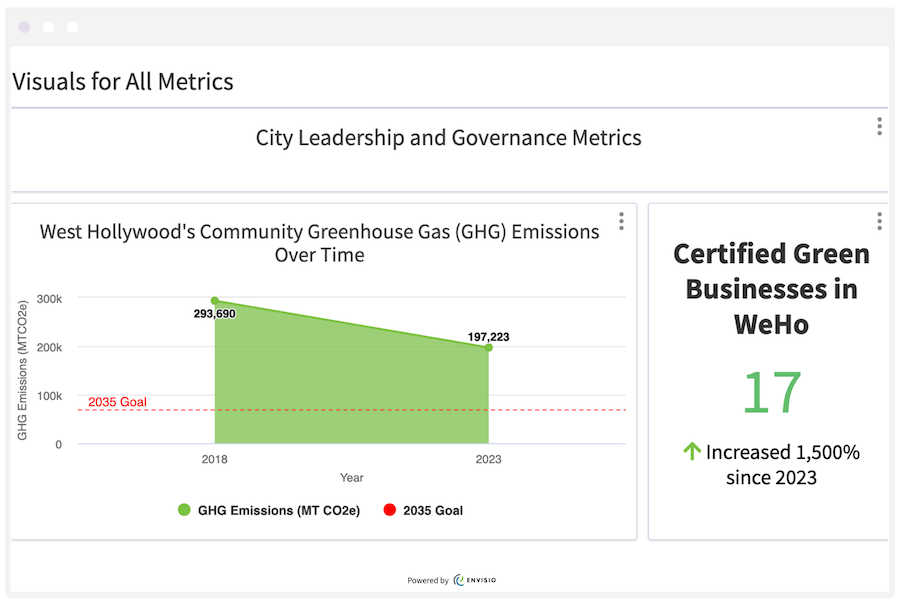
The city recognizes that incentives are good, but they are not enough on their own to reach their goals. The cross-sector WeHo Green Business Program promotes energy and water efficiency, waste reduction, and sustainable and/or local purchasing with the city’s business community.
Climate Action Plan Example 5: The City of Richfield, MN
Another incredible example of measuring financial sustainability (as well as developing a robust infrastructure that is a perfect example of data transparency…) is the City of Richfield. Their public dashboard very clearly shows their efforts in sustainable infrastructure financing: they display exactly what changes they are making and how much those changes cost. They have high priority climate action plan items that they are working hard to achieve by 2025.
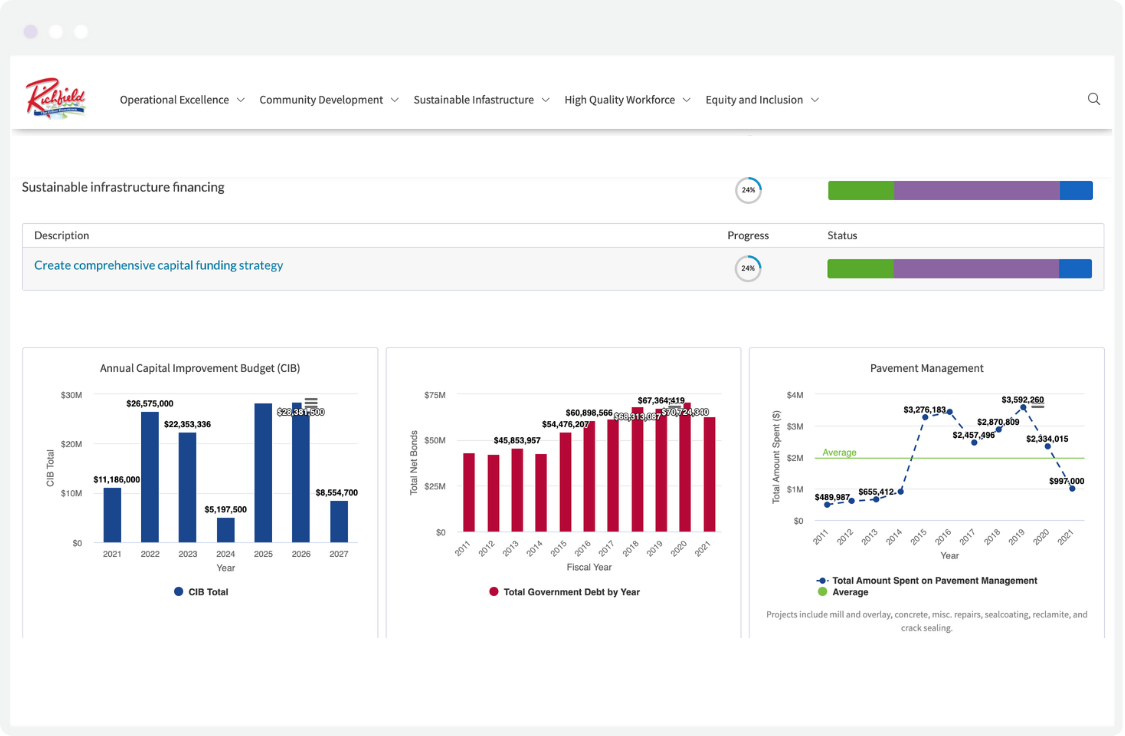
Showing your financial steps towards sustainable infrastructure, decarbonizing the economy, and engaging in sustainable development practices are ways in which municipal governments can make significant impacts. City leaders and policy makers have a unique opportunity to advance such incentives, and make climate action plans an economically viable option.
Engaging stakeholders, business owners, and seeking federal funding are all ways a municipal government can promote the uptake of renewable energy and energy efficiency. Having buy-in at the leadership level promotes the financial feasibility of climate action, and this is the type of action that translates into a sustainable climate action financing strategy.
Incorporating Climate Adaptability
The ability to adapt to climate change is another key indicator of a strong climate action plan. Even if global emissions are sharply reduced, the climate will continue to change, and adaptation will remain necessary. Strong plans include measures that build resilience to impacts such as sea level rise, droughts, floods, wildfires, air pollution, water contamination, and heatwaves.
Climate Action Plan Example 6: The City of Rockville, MD
The City of Rockville is advancing adaptability and resilience as core features of its strategic climate action planning through a series of collaborative efforts and proactive measures.
Their plan is multifaceted, holistic, and comprehensive, but a few stand-out strategies regarding resiliency deserve a shout out!
Partnering with Montgomery County and community organizations, Rockville contributed to an urban heat mapping project funded by a National Oceanic and Atmospheric Administration (NOAA) grant. In August 2022, nearly 600 volunteers equipped with heat sensors mapped temperatures across neighborhoods, including Gaithersburg, Germantown, Rockville, Silver Spring, Bethesda, Fairland, and Olney.
The data will inform better integrated tree canopy, land use, impervious surfaces, and heat maps.
This project will help areas most at risk from urban heat islands for targeted mitigation and priority based resource allocation, focusing on protecting vulnerable populations such as seniors, infants, outdoor workers, and those without air conditioning.
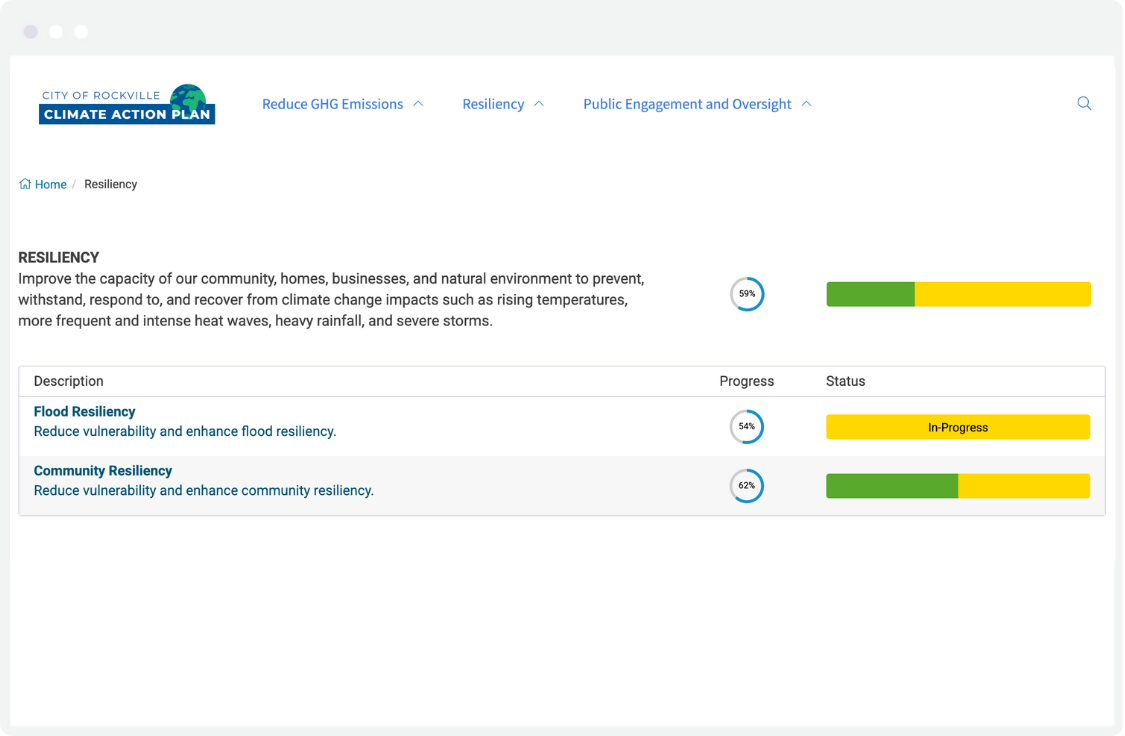
Additionally, Rockville is enhancing flood resilience by partnering with the Federal Emergency Management Agency (FEMA) to update Flood Insurance Rate Maps and advocating for updated stormwater infrastructure standards. The city is also assessing its flood risk to develop a Flood Resiliency Master Plan aimed at reducing or mitigating the impacts of flooding.
Putting Hope Into Action
We know that addressing climate change requires coordinated action at all levels, from individuals to governments, to industry bodies and international organizations. But cities and counties are in a unique position to get buy-in, make big moves, and reduce their impact. Tangible actions like gathering data on potentially vulnerable populations or areas in a community, or installing green infrastructure, are all actions we hope local governments feel empowered to do. We are proud of the Envisio cities and counties who are leading the charge by putting hope into action.
Schedule a Demo ↓
At Envisio, we help municipalities track, report, and achieve their strategic priorities. Schedule a free demo with one of our strategy experts to learn how Envisio can help your organization achieve its goals and elevate performance.
Drop us a line to talk about your municipal strategic priorities, and schedule a free demo of Envisio now! We look forward to showing you how we can help you get aligned, and get results.
See Envisio in Action
See why public sector teams choose Envisio to plan, track, and report on what matters.
- Centralize performance data
- Automate progress reports
- Publish dashboards for the public
Frequently Asked Questions
Common questions about municipal climate action planning, from what belongs in a plan to how cities track and fund the work.
Five things come up again and again across the plans we see: managing and valuing natural assets, using data to guide decisions, investing in green infrastructure, securing leadership buy-in and financing, and building in adaptability.
A strong plan addresses both the causes and the impacts of climate change, and it sets goals that are specific and time-measured enough to track.
According to the United Nations Environment Programme, cities and urban areas account for an estimated 75% of global energy-related emissions, with transportation and building developments as the largest contributors.
Local governments are also the first responders to flooding, extreme heat, and wildfire. They sit at a useful scale for this work, large enough to drive systemic change and close enough to the community to respond to specific local vulnerabilities.
Natural assets are forests, wetlands, streams, marshes, and urban tree canopy. They deliver services a municipality would otherwise have to engineer and pay for, including carbon storage, stormwater management, and erosion prevention.
A growing number of municipalities now inventory their natural assets, assign a value to the services those assets provide, and fold them into the overall asset management system alongside roads, pipes, and buildings. Valuing them this way makes planning and development trade-offs much easier to weigh.
Most commonly through a public dashboard that reports status updates and performance measures against each strategy. You can browse a set of climate action plan dashboards to see how this looks in practice.
Clear targets give the tracking something to measure against, whether that is a tree canopy percentage by a set year or science-based emissions targets adopted by council. Reporting against those targets in public turns a commitment into work that can be checked.
Choosing the right measures is its own task. Per capita greenhouse gas emissions, share of energy from renewable sources, water consumption, and tree canopy coverage are all commonly tracked. We go through these in more detail, with examples, in our post on climate action plan performance measures.
Financing is where most climate plans get tested. A few approaches show up repeatedly: publishing the cost of each change so residents can see the investment; pursuing federal, state, and provincial grant funding for specific projects; and green business programs that bring the local business community into energy efficiency, water efficiency, and waste reduction work.
Leadership buy-in matters here more than anywhere else, because it is what moves climate work into budget and capital decisions rather than leaving it as a standalone commitment.