
Summary
Going from strategy to implementation in local government depends on employee engagement, leadership alignment, well thought-out goals, and consistent communication — not just a well-written plan. This post explores how governments are turning strategy into action by making participation easier, celebrating progress, and keeping plans visible day-to-day.
This post covers:
- Why involving staff early leads to stronger buy-in and better action plans
- How strategy champions sustain momentum after planning
- Ways to humanize reporting with stories, wins, and regular updates
- Why SMART goals are so important for strategic plan execution
- Why celebrating small wins builds long-term accountability and morale
Strategic plan implementation in local government requires committed team work. You can craft a brilliant strategic plan, but without engaged employees pushing it forward, that plan is likely to stall out. But what are the best practices for strategic planning, and for getting your employees engaged? And how do you get staff not only to buy into the plan, but to actively participate in making it a reality?
In this post, we’ll explore four proven best practices for strategic planning that focus on implementation, and engaging your employees at every step. Along the way, we’ll highlight real success stories—from a city that achieved 100% staff participation, to a public library that turned its strategy into a game—to show how you go from strategy to execution.
Let’s dive in.
1. Involve employees and leaders early and often in planning
The best way to ensure strategy execution and implementation is being sure your leaders and employees are invested in your strategic plan. A good way to do this is making them feel like they’re a part of it.
Top strategy implementation tip:
Don’t limit planning to a small executive team; bring in voices from all levels of the organization.
When staff across departments help shape the plan, they’re more likely to understand it and commit to it.
Soliciting feedback from employees at all levels will ultimately strengthen your plan, because front-line workers often have solid insights when it comes to knowing what ought to be measured, the specific actions that can be taken, or how progress can be determined. The folks doing the day-to-day work can offer practical insights that top leadership might overlook!
When employees participate early, the plan becomes “ours”, which is hugely important for long-term commitment.
And, it’s not just front-line staff who need to be involved—leadership engagement from the start is critical as well. Active leadership can make or break a strategic plan.
Spotlight: City of Minnetonka, Minnesota
One great example of best practices for strategic planning comes from the engaged employees and leaders at the City of Minnetonka, Minnesota.
Minnetonka’s strategic execution success can be traced, in part, to their leaders opening up their planning process to extensive input from staff (and even residents) before finalizing their strategic plan. They conducted a community-wide survey to gather public feedback, then held planning meetings with 6 department heads, 40 supervisors, and many of the city’s 170 full-time employees to brainstorm goals and actions.
As City Manager Mike Funk explained to us, “Staff’s role is to create the work and the performance measures that feed up into the plan’s pillars.”
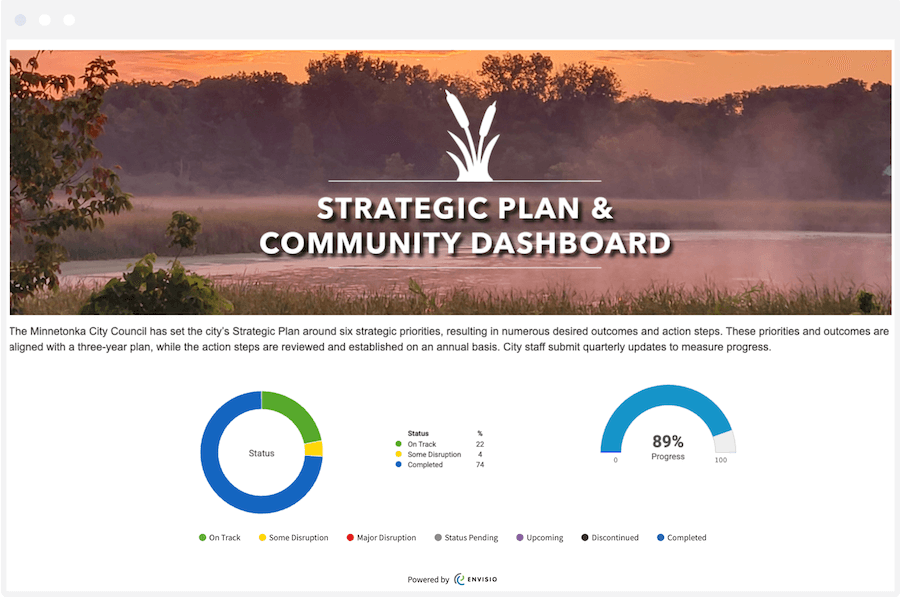
Minnetonka’s 2025-2027 Envisio-powered public dashboard shows the six strategic priorities that guide the city’s strategic plan. Many employees have (literally) had a seat at the table creating action steps that fed into the city’s performance measures and key outcomes. By involving staff in this way, the city ensured everyone could see their ideas reflected in the plan and understand how their work would contribute.
2. Empower champions and make participation easy
Even with a great plan in place, implementation can falter without the right support structure. To maintain momentum after the planning stage, identify a network of strategy champions and equip them (and all staff) with the tools and training to succeed.
Top strategy implementation tip:
Designate department champions or project leads who can act as the plan’s cheerleaders and coaches within their teams.
Naming one person per department as the go-to “strategy guru” creates a point person who can answer questions, provide encouragement, and keep everyone on track.
These internal champions should be people who understand the value of the strategic plan and are enthusiastic about it.
They don’t need to be senior managers either—often a passionate front-line or mid-level employee can inspire peers by example.
Spotlight: Port Moody, British Columbia
It’s worth noting that when you get the combination of champions + good, user-friendly processes right, the payoff can be huge.
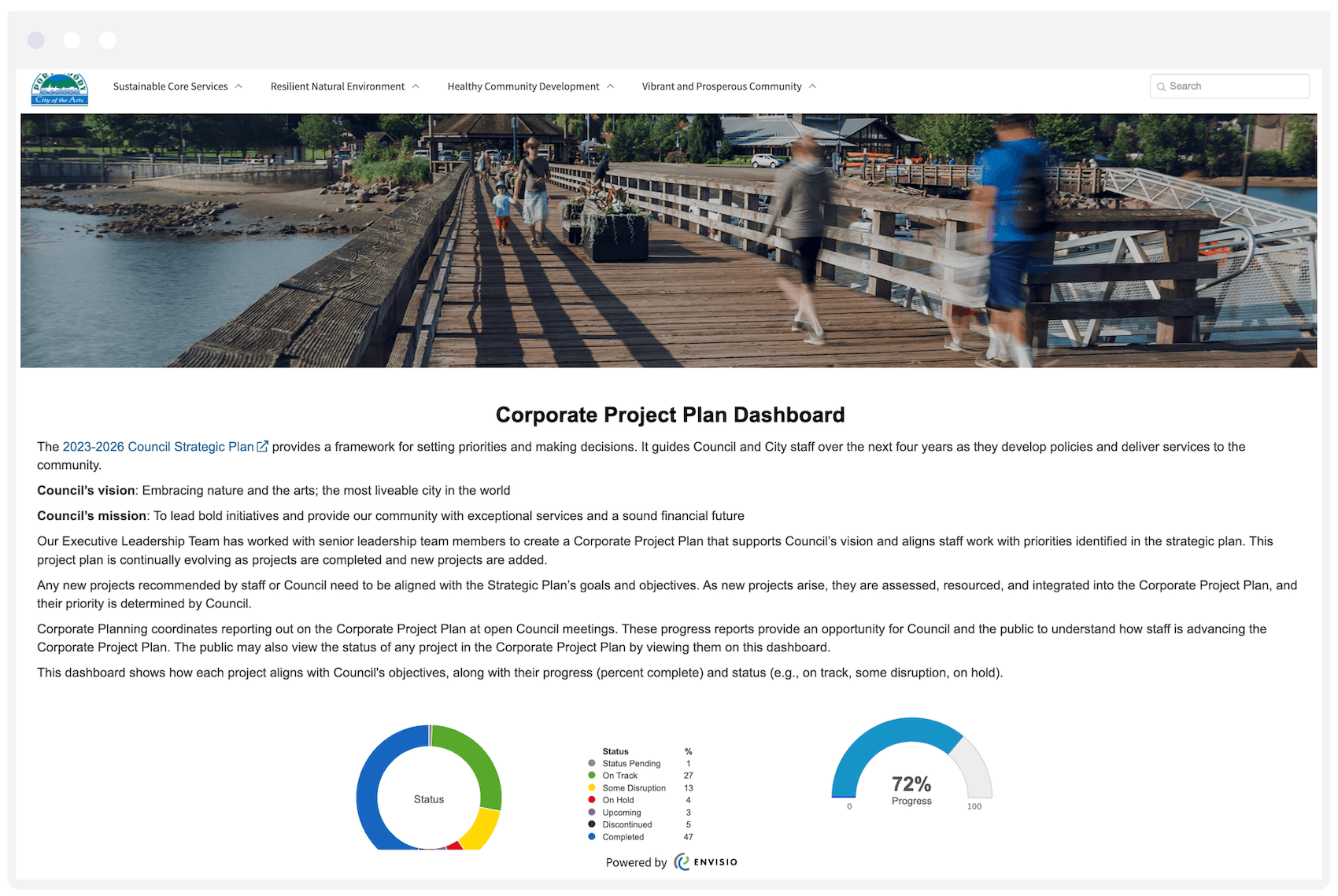
The City of Port Moody’s 2023–2026 Corporate Project Plan builds on a strong foundation of strategic planning and staff engagement. The plan is structured around four priority areas that reflect the city’s long-term vision for excellence and community well-being:
- Sustainable Core Services – delivering reliable services, financial sustainability, and good governance.
- Healthy Community Development – supporting balanced growth, active transportation, and community wellness.
- Vibrant and Prosperous Community – advancing economic development, arts, culture, and placemaking.
- Resilient Natural Environment – protecting natural assets and leading on climate action and sustainability.
“One of the reasons that we were so successful and achieved 100% buy-in is that staff could really see how providing their updates made a difference in the work that they’re doing.” – Ian Smedley, former Corporate Planning Advisor, Port Moody, BC
Crucially, the plan’s strategic plan implementation success stems from alignment between City Council and the Executive Leadership Team. Council set the vision, and staff developed a corporate project plan to bring it to life. This alignment, backed by visible leadership support, helped Port Moody achieve 100% staff participation in their previous plan—and created a strong foundation for their new one, which you can explore using their Envisio powered public dashboard.
3. Highlight strategic implementation success
Ideally, a strategic plan is able to function as a living document. That means keeping everyone informed about progress, wins, and challenges on a regular basis.
Top strategy implementation tip:
Ongoing communication sustains interest and ensures the plan stays top-of-mind amid daily workloads.
One best practice for going from strategic plan to implementation? Establish a consistent reporting rhythm. Many local governments share strategy updates monthly or quarterly with leadership—but it’s just as important to share progress with all staff. This could be a quick all-hands update, a staff newsletter, or a dedicated intranet page. The format doesn’t matter as much as the frequency. Regular updates show that the strategic plan is active, leadership is engaged, and staff contributions are seen and valued.
Another thing to remember is, it’s important to highlight stories, not just stats. Data matters, but it’s important to be able to translate that into a narrative that lands. It’s the human wins that resonate! If a team hits 100% of its targets, share how they did it! If a frontline idea sparks real impact, spotlight it. A quick weekly email or shoutout can go a long way in making strategy feel personal and relevant.
Finally, don’t rely on just one channel. Mix it up—emails, dashboards, staff meetings—because people absorb info differently.
The goal is simple: every employee should know how going from strategy to implementation is progressing, and where they fit in.
When that’s clear, engagement follows, and strategic plan implementation becomes much more straightforward.
Spotlight: Denver Public Library, Colorado
At Denver Public Library, the Strategy and Evaluation team knew that simply sharing data wouldn’t inspire staff. So, they made strategy fun.
To boost engagement, they created the “Road Atlas”, a gamified program that showed staff how their roles connected to strategic goals. Employees earned points by learning about the plan and updating how their work contributed to it.
Teams competed, celebrated milestones, and embraced their role in advancing the library’s mission. Small rewards like pins and bragging rights kept things lively, but the real win was deeper understanding and buy-in.
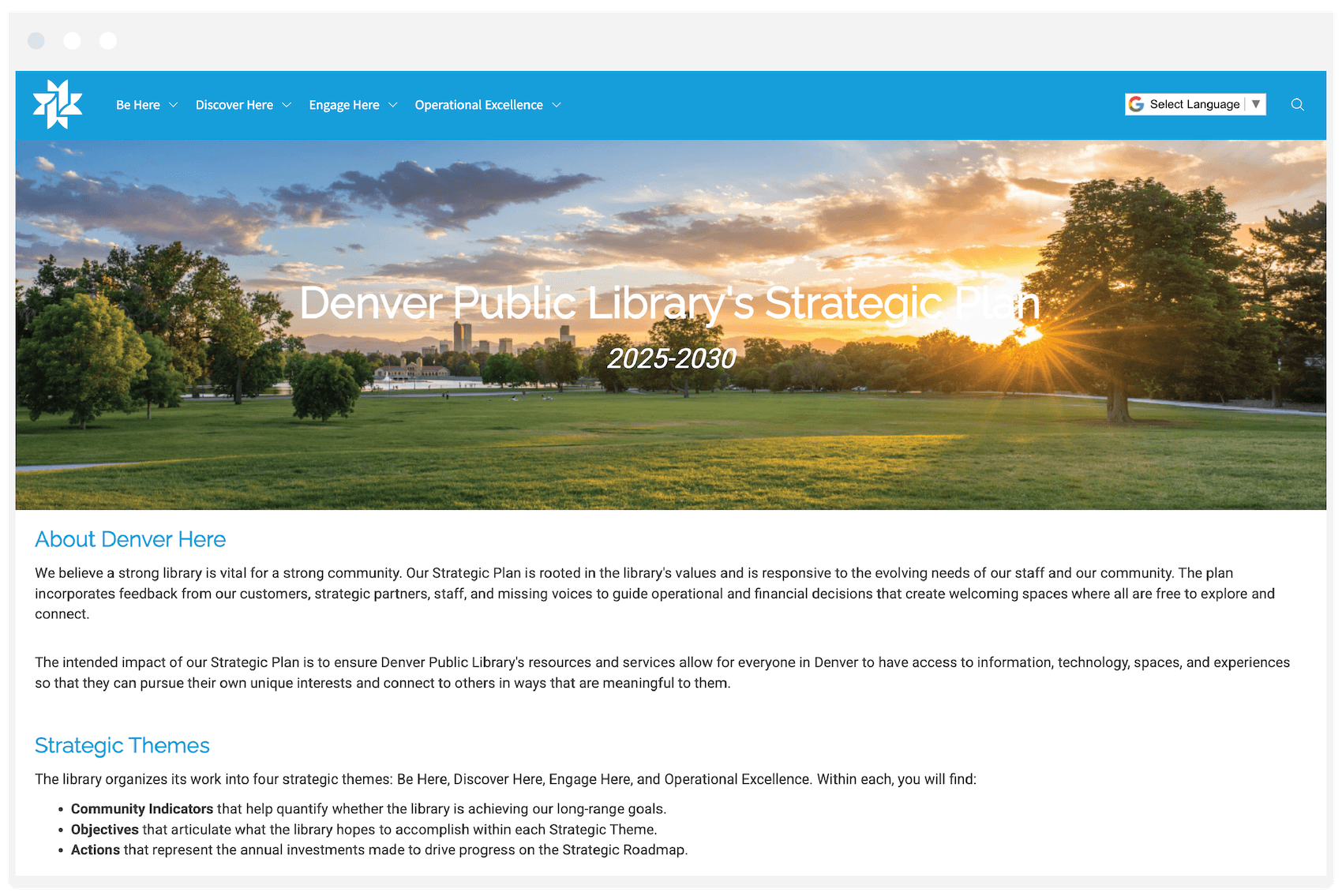
“We work to highlight wins and successes, and then we talk about what the challenges have been and what kind of support is needed to move forward. We bring everyone together, our entire executive team, once a quarter to review all these action items.” – Kirsten Decker, Manager of Strategy and Evaluation, Denver Public Library, CO
Under their Operational Excellence priority on their 2025 – 2030 Strategic Plan public dashboard, you can see the ways that DPL is actively working to:
- Create a “People Strategy” that supports staff development and aligns with organizational goals.
- Evaluate and reimagine performance management to better connect individual contributions to strategic outcomes.
- Invest in learning and development to build the skills needed to deliver on the Strategic Plan.
- Foster deeper employee engagement through a work environment where staff feel motivated, connected, and invested in success.
These efforts are already in motion, with several initiatives on track, and others evolving through feedback and experimentation.
4. Make sure goals are SMART
One of the most common reasons strategic plans stall after approval is that the goals inside them are too vague to act on.
When objectives lack clear owners, timelines, or measurable targets, implementation becomes a matter of interpretation — and interpretation leads to inconsistency.
Top strategy implementation tip:
Defining goals that are SMART: Specific, Measurable, Achievable, Resourced, and Time-bound gives departments something concrete to work toward, and gives leadership something meaningful to report on.
SMART goals are what make progress visible. Without them, it’s difficult to know whether a department is on track, behind, or finished. That ambiguity erodes reporting discipline. People stop updating plans because there’s nothing concrete to update. With well-defined objectives, departments can log real progress at each reporting interval, track what’s been completed, and communicate clearly to both internal leadership and the public about where things stand.
Spotlight: City of McKinney, Texas
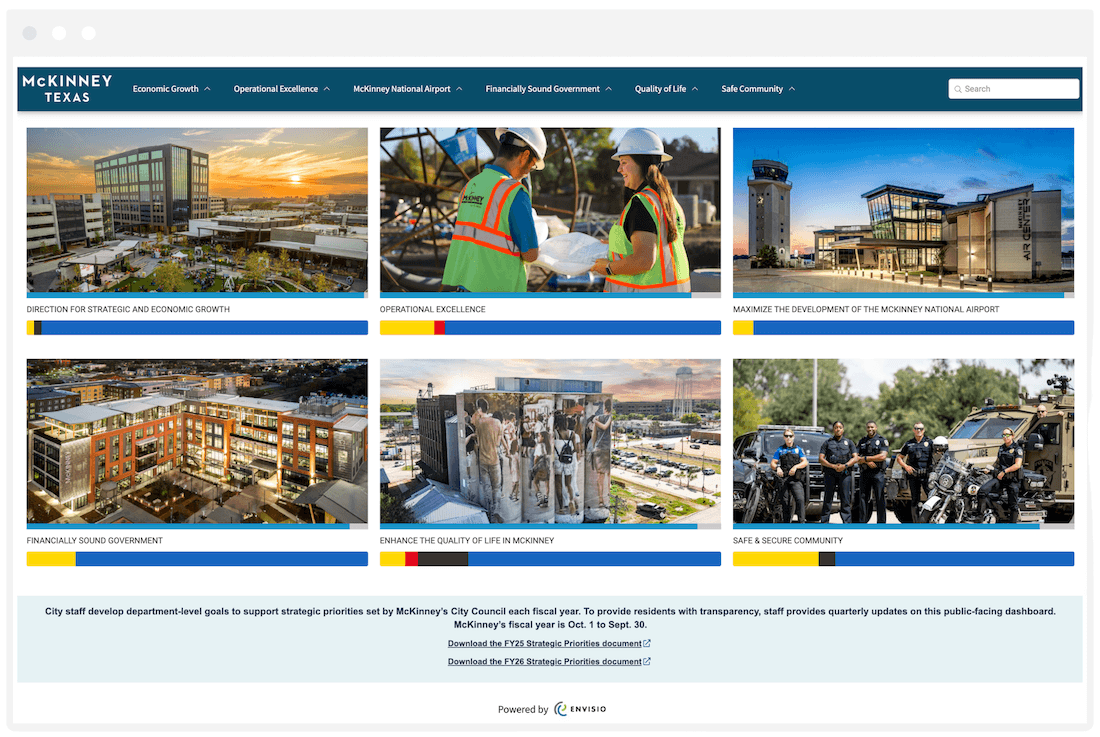
The City of McKinney’s public performance dashboard shows what SMART goal-setting looks like in practice across a city’s departments. Each department has defined specific, time-bound objectives tied to the city’s broader strategies — tracked and updated publicly, with clear records of what’s been completed and when.
One objective from the Organizational Development & Performance Management team captures the approach well: delivering at least 20 customized training sessions to front-line employees across specific departments by September 30, 2025. By the end of the fiscal year, they had conducted sessions for Parks & Recreation, Procurement, HR, Municipal Court, Housing & Community Development, and the Executive Leadership Team — hitting the target, and documenting exactly how they got there.
–
Strategic plan implementation is both an art and a science. As these best practices show, it takes a mix of inclusive planning, good goal setting, supportive leadership, and clear communication of big (and incremental) progress. Public sector work is often challenging, abstract-feeling, and complex. By involving staff from the start, empowering them with training and champions, staying SMART with your goals, keeping the plan visible day-to-day, and celebrating their efforts, you create a culture around your shared mission. These tactics are practical and proven, and they can transform your strategic plan from a static document into a living, breathing success story powered by engaged employees.