Summary
An effective economic development plan gives local governments a structured roadmap to drive sustainable growth, align stakeholders, and translate strategy into measurable results. This framework moves from assessing community conditions and building leadership teams to executing initiatives and keeping progress visible through continuous performance tracking.
Key Takeaways
- Data-driven planning and cross-sector collaboration are key for sustainable economic growth.
- Clear actions, defined ownership, and KPIs turn strategy into accountable results.
- Ongoing monitoring keeps the plan adaptable, relevant, and impact-focused.
Economic development plans are essential for sustainable growth, job creation, and a thriving community. Without a plan, communities are forced to react to external economic forces rather than proactively shape their future. Having a strategic roadmap ensures that economic growth is intentional, measured, and community-focused.
- A strong economic development plan considers:
- Population trends (growth or decline)
- Economic shifts (booms or stagnation)
- Workforce development and job creation
- Public-private investment opportunities
- Land use and sustainable housing growth
- Arts, culture, and community amenities (don’t underestimate what this can contribute!)
A robust economic development strategy integrates a region’s unique assets, addresses challenges, and sets a long-term vision. It requires leveraging tools that will help to deliver projects on budget and on time (like Envisio Projects), and having a firm understanding of your community and your key collaborators.
So where do you start?
A successful economic development strategy typically follows five steps: assess your community, build the right team, create a measurable plan, implement it, and keep it updated over time.
Step 1: Assess Your Community’s Strengths and Economic Needs
Strategic economic development planning is a continuous process, often reviewed annually and updated every 3-5 years to keep up with shifting economic landscapes. If your community doesn’t have a formal plan—or if your current plan is outdated—now’s the time to take action.
Before formal planning begins, initiate informal discussions with key contributors. These conversations help with assessing the local economic landscape, build support, and lay the groundwork for assembling a project team (see step 2).
These early conversations provide:
- Buy-in from key decision-makers to ensure long-term success.
- Insights into community perceptions of local economic development.
- An opportunity to recruit team members for the planning process.
Key Actions:
- Clarify the “why” – Develop a concise statement on why a strategic economic development plan is both timely and necessary.
- Engage key players – Hold informal discussions with local government, business leaders, and community organizations.
- Gather insights – Gather data, identify challenges, opportunities, and diverse perspectives on economic priorities.Understanding the data around your demographics, employment, and infrastructure is an important step in honestly assessing your community’s current economic state, its assets, and its challenges. A SWOT analysis (Strengths, Weaknesses, Opportunities, Threats) is a common tool at this step, but there are other strategic planning models and exercises you might use.
Example 1: City of Denton, TX
Faced with a rapidly changing economic landscape and the impacts of the COVID-19 pandemic, Denton undertook a strategic economic development planning process. Through wide-ranging engagement (including an Economic Development Partnership Board, extensive consultations with City Council, as well as businesses, educators, and residents), data collection (including Business Retention and Expansion visits and surveys), and a SWOT analysis, the Denton team was able to understand and identify the right focus areas for their community.
The City of Denton’s core strengths? Entrepreneurial spirit and cultural vitality.
Their weaknesses: Limited resources dedicated to economic development compared to surrounding communities.
Opportunities included planned developments like Cole and Hunter Ranch.
The identified threats were largely around economic fallout from the COVID-19 pandemic.
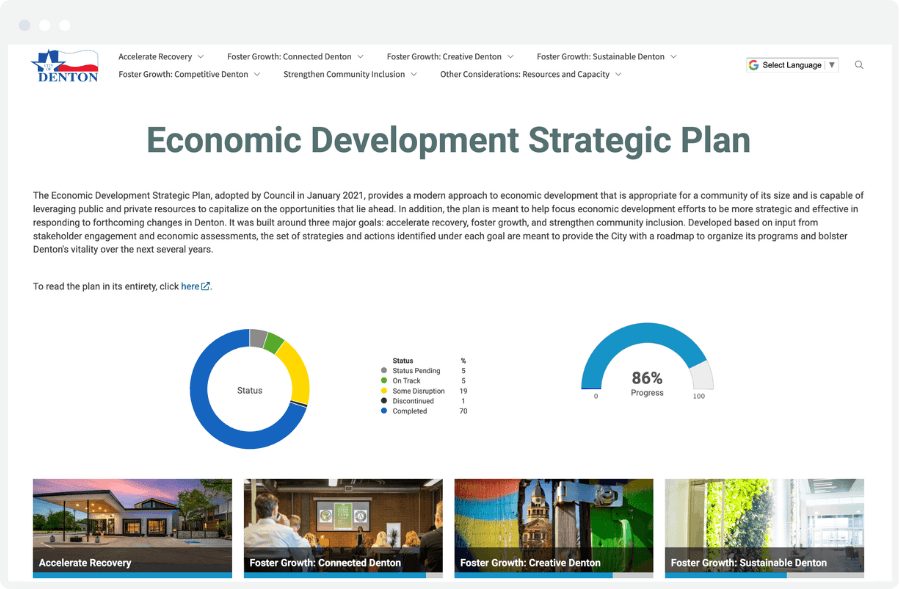
Denton shares progress on its economic development strategy through a public dashboard that tracks strategic initiatives and reports their status—from projects that are on track to those experiencing disruption.
The dashboard currently shows 86% overall progress, allowing residents and leadership to follow how initiatives such as Connected Denton, Creative Denton, and Sustainable Denton are advancing the city’s long-term economic vision.
Unlike a simple “more jobs” approach, Denton’s plan focuses on targeted strategies aligned with its guiding principles: core resiliency, future-focused, inclusive growth, entrepreneurial spirit, cultural vitality, connectivity, creativity, sustainability, competitiveness.
Step 2: Gather the Right Team for Strategic Economic Development
Economic development is about creating an ecosystem that supports residents, businesses, and infrastructure for long-term success. Whether your community is experiencing rapid growth, economic stagnation, or workforce retention challenges, a well-crafted plan provides a blueprint for sustainable prosperity.
But how do you create an ecosystem that supports residents, businesses, and others? Well, you don’t do it alone!
You’ll need a team of key people who bring diverse perspectives and expertise to the table.
Key players might include:
- Local government representatives (council members, economic development staff).
- Business leaders and entrepreneurs with insight into industry trends.
- Community organizations that support workforce and economic growth; it is a good idea to include both business administrations and organizations that work with disadvantaged groups.
- Educators and workforce development professionals who understand labor needs.
- Regional and state economic development agencies, to ensure broader policy alignment.
Key Actions:
- Establish roles and responsibilities – Define each team member’s role in the process of the strategic economic development plan. Assign responsibility for specific research, outreach, or coordination efforts.
- Develop an action-oriented approach – Identify “quick start” initiatives—short-term actions that demonstrate momentum. This will make it easier to facilitate buy-in with elected officials or other regional partnerships.
- Outline longer-term projects – Looking to the future will help with the overall vision and direction of your plan. Looking at long term projects will also help in responding quickly to funding opportunities as they arise.
A well-structured team is essential for turning ideas into action.
Example 2: City of West Hollywood, CA
West Hollywood has taken a strategic and transparent approach to economic development by using a public dashboard to track progress on its Economic Study.
The initiative brings together city leadership, businesses, and community stakeholders to understand the city’s economic strengths and identify opportunities for sustainable growth.
The Economic Development Study focuses on strengthening West Hollywood’s unique economic ecosystem—particularly industries such as entertainment, media, arts, and hospitality—while also supporting small businesses and local entrepreneurship. By gathering economic data and stakeholder input, the city has created a shared understanding of where investment and policy attention should be focused.
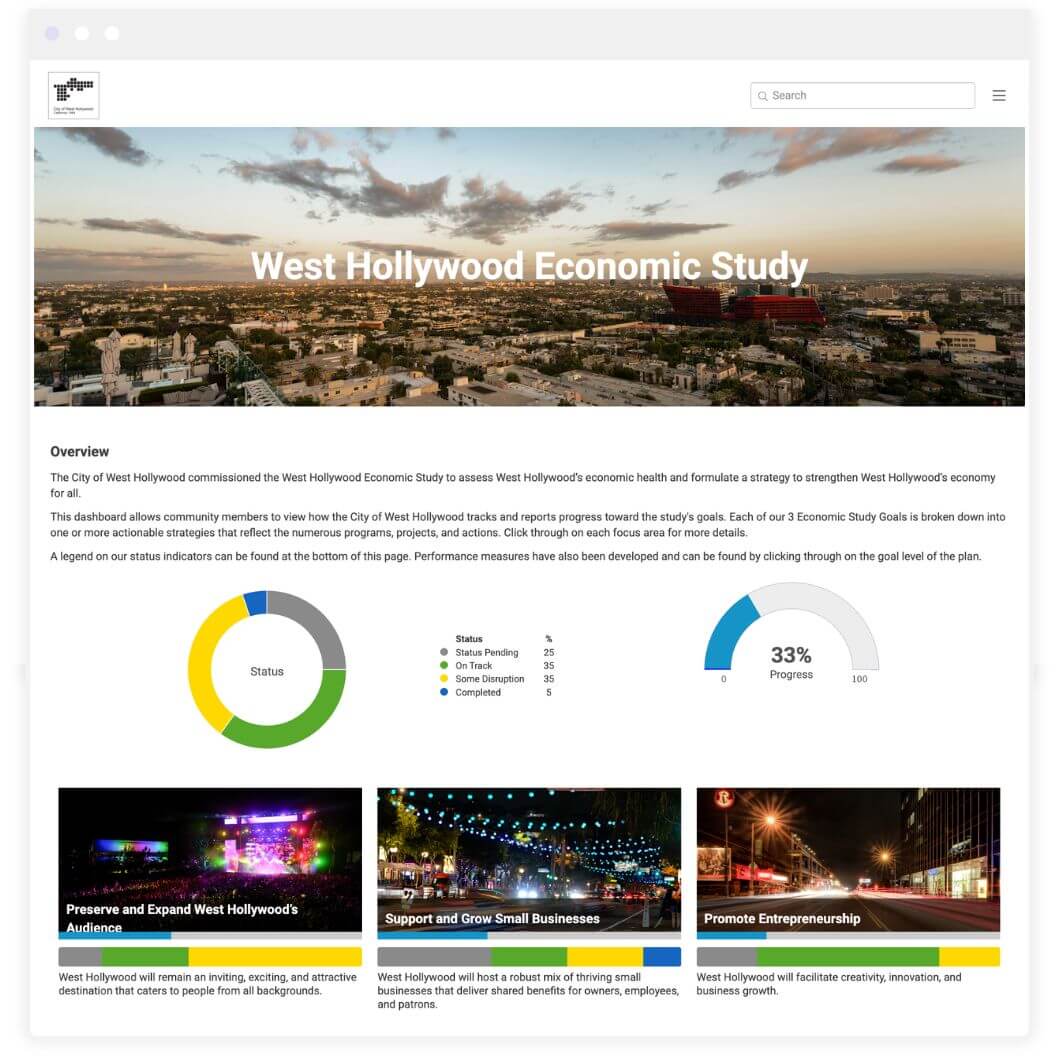
West Hollywood’s public dashboard highlights how different initiatives connect to broader economic priorities, including business retention, workforce opportunities, and maintaining a vibrant commercial environment. Publishing these initiatives and metrics publicly allows leadership and residents to see how economic strategies are progressing and where adjustments may be needed.
West Hollywood’s approach demonstrates how assembling the right mix of team members, data, and transparency tools can help communities cultivate an environment where economic development initiatives are aligned and actionable.
Step 3: Craft a Clear, Actionable Plan with Performance Measures
Creating an actionable plan serves as the bridge between strategic vision and tangible outcomes.
This stage may involve developing a capital improvement plan (CIP) as an outline for long-term infrastructure investments (roads, utilities, parks, etc).
Creating an actionable economic development plan demands careful attention to detail; balancing ambition with pragmatism. A well-structured plan aligns expectations, secures long-term commitment, and ensures accountability. At its core, the plan outline should be built on SMART goals—Specific, Measurable, Achievable, Resourced, and Time-bound—ensuring that objectives are clear and progress can be tracked.
The buy-in obtained earlier now plays a critical role in defining concrete initiatives, assigning responsibilities, and setting realistic timelines.
A strategic economic development action plan outline should be ambitious yet practical. Keep it simple and structured. The plan should be backed by thorough research, including economic and demographic data, market trends, and community input. It should also be flexible enough to adapt to unforeseen challenges and opportunities.
Key Actions
- Categorize actions – Determine which actions are one-time projects, recurring activities, or large-scale initiatives, like a CIP.
- Measure what matters – Define key performance indicators (KPIs) to measure success.
- Develop a concise, structured action plan – This will typically start out as a one-page document (although, we strongly recommend using a tool such as Envisio for translating the plan into a trackable, dynamically updated, “living” plan).
- Assign responsibilities and set realistic timelines – It is better to underpromise, than it is to overpromise.
- Budget, budget, budget – Make a case for why your priorities ought to be resourced by the budget.
Example 3: City of Corona, CA
The City of Corona, California, offers a strong example of how a well-defined economic development action plan can drive results. Their 2021-2026 Strategic Plan established clear priority goals, outlined key actions, and created a framework to track and report progress. Their approach demonstrates the power of structured planning and accountability in local government.
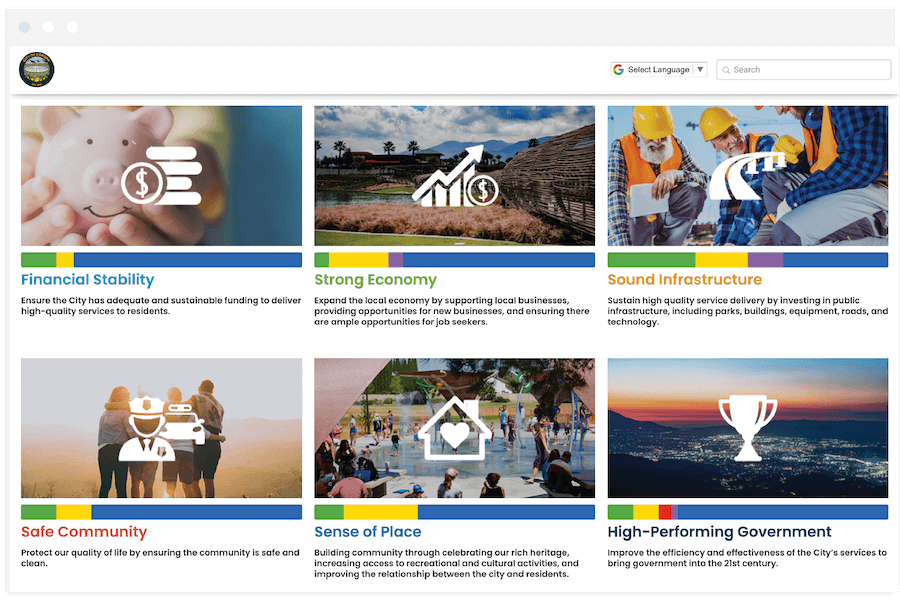
Corona’s plan stands out as a strong example of strategic economic development when it comes to creating an action plan, because as we can see on their public dashboard, their plan translates broad strategic priorities—such as fostering a high-performing government and improving sense of place—into concrete actions.
The city’s commitment to KPIs in areas like economic development, public works, and planning & development ensures that progress is measurable and publicly reported.
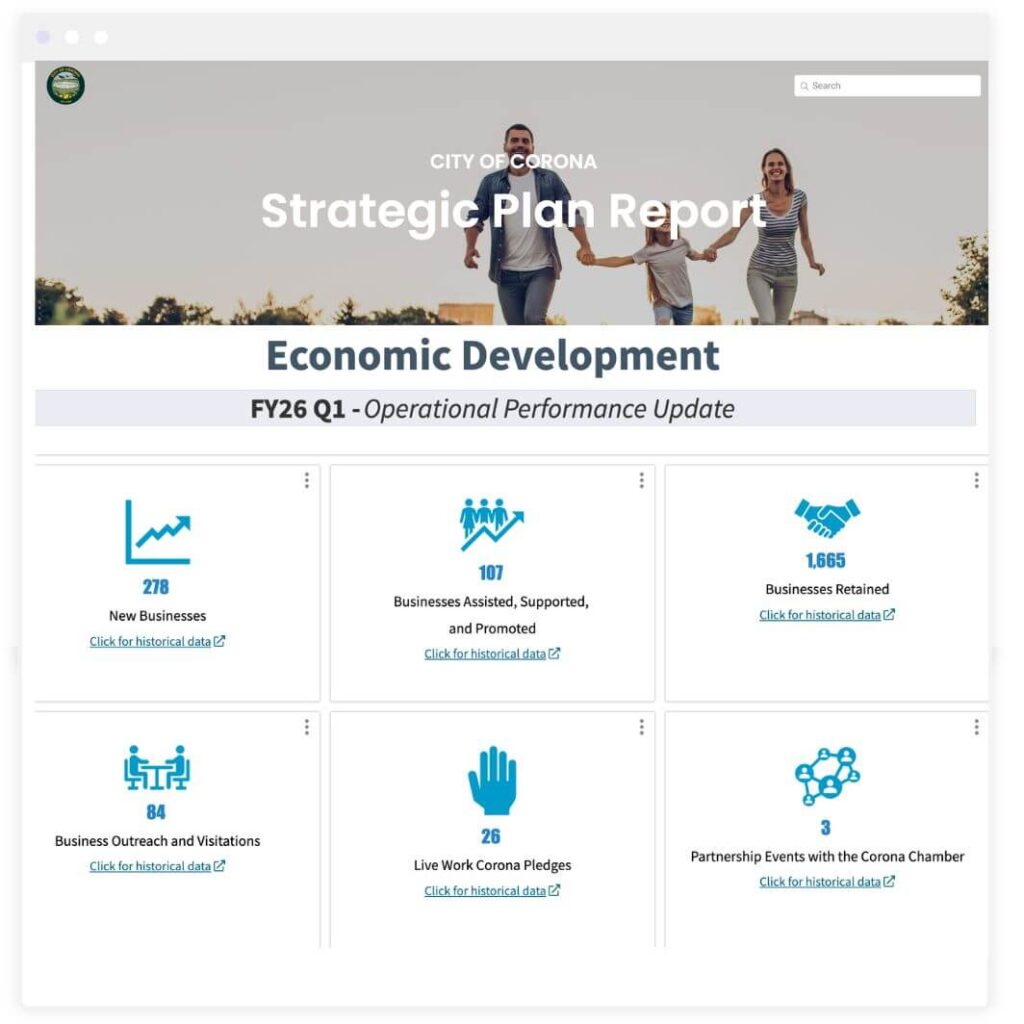
Corona uses various KPI reports, such as their economic development report, which lets residents and leaders track performance metrics and initiative progress.
Step 4: Put Your Economic Development Plan into Action
A strategic plan without execution is just wishful thinking. Implementation is where the magic happens—where strategic vision transforms into real-world impact. For an economic development plan to succeed, it must move beyond policy documents and into actionable steps that generate measurable results.
Quick-win initiatives, such as launching an annual economic development report card, creating a business directory, or holding business roundtables, help build early momentum. Meanwhile, long-term projects like new business district development, workforce training enhancements, or infrastructure investments drive sustained economic growth.
Key Actions:
- Prioritize projects by categorizing them into short-, medium-, and long-term goals.
- Assign clear responsibilities and deadlines to ensure accountability and sustained momentum.
- Establish a funding strategy by identifying grants, partnerships, and budget allocations.
- Track progress with regular check-ins and updates, using public dashboards and internal reporting to maintain transparency and agility.
A well-executed strategic plan is both structured and adaptable. Regular progress reviews, public engagement, and technology-backed reporting tools help local governments stay on track and demonstrate accountability to their communities.
Example 4: Richland County, SC
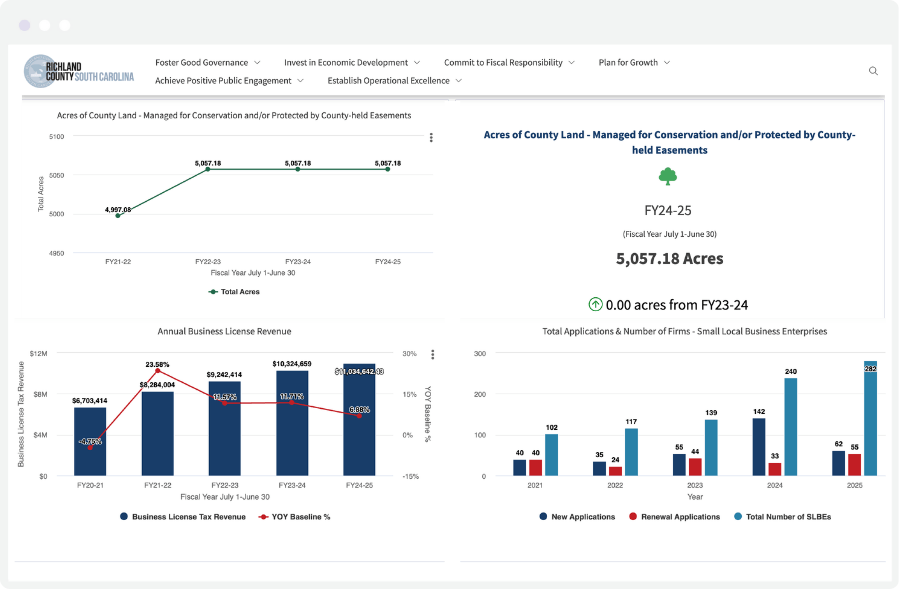
Richland County demonstrates step four by using measurable performance metrics to guide and track economic development progress.
The county has established clear economic development targets tied to strategic priorities such as supporting small and local businesses, strengthening workforce opportunities, and encouraging sustainable investment across the region. Through their public dashboard, Richland County tracks indicators related to Small Local Business Enterprise (SLBE) participation and other economic development outcomes that help leaders understand whether initiatives are producing results.
By connecting these metrics to strategic goals, the county can prioritize programs that expand opportunities for local businesses while strengthening the broader economic ecosystem. Public reporting also makes it easier for leadership, partners, and residents to see how economic initiatives are progressing and where additional focus may be required.
Richland County’s approach highlights how economic development plans move from vision to action when clear metrics, accountability, and regular progress tracking are built into implementation.
Step 5: Keep the Plan Alive with Regular Updates
The economy doesn’t stand still, and neither should your economic development plan. It needs to be a living document, agile enough to adapt to changing circumstances while still maintaining a clear focus on your community’s long-term vision.
This means regular reviews, updates informed by economic data and performance metrics, and, importantly, feedback from the community itself. This keeps your approach fresh, relevant, and ensures you maintain momentum.
Keeping a plan like this alive and active can be a challenge. It’s easy for even the best-laid plans to get bogged down in spreadsheets, scattered emails, and disconnected project management tools that lead to a lack of visibility. Using a technology partner can be helpful.
Key Actions:
Make updates easy by choosing the right technology partner.
- Consider getting a central hub – It’s important to have a place where you can consolidate all the elements of your economic development plan. For instance, Envisio offers a way to bring everything together: your strategic goals, the specific projects designed to achieve them, and the tracking of progress – all in one place.
- Communicate progress – External-facing dashboards and internal reports help connect the dots between individual initiatives and the bigger picture. Being transparent about performance ensures that all collaborators have visibility into progress and can make data-driven decisions as conditions change or obstacles arise.
Example 5: City of Oldsmar, FL
The City of Oldsmar demonstrates step five by keeping its economic development plan active through regular updates and publicly reported performance metrics. Through their public dashboard, the city tracks progress toward economic development goals designed to cultivate a vibrant local economy that supports businesses, creates employment opportunities, and strengthens Oldsmar’s overall competitiveness.
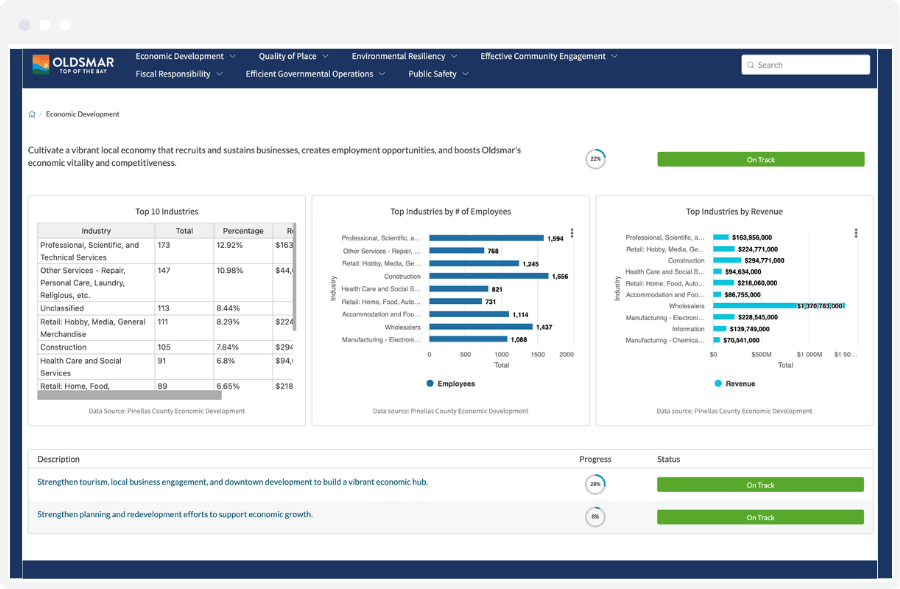
Oldsmar pairs key performance indicators with regular progress updates so residents and leadership can see how initiatives are advancing. The dashboard highlights industry data, tracks the status of projects, and shares updates on initiatives such as partnerships with the Upper Tampa Bay Chamber of Commerce, redevelopment projects like the Odeon mixed-use development, and tourism efforts that support the local economy.
By regularly updating project progress, accomplishments, and next steps, Oldsmar ensures its economic development strategy remains visible, measurable, and responsive to the community’s evolving needs.
Economic development is a long game.
A strategy implementation and performance management platform provides a long-term view of capital investments, allowing communities to see how these projects will contribute to economic growth over time.
↓ Get Your Plan Moving Today ↓
Strategic economic development planning is about taking tangible steps to make your vision a reality. With a clear plan, a committed team, and the right tools, your community can drive real economic growth and create a thriving environment for businesses and residents alike.
Ready to take your economic development planning to the next level? Talk to our team about how to get your plan visible and moving forward, your team aligned, and reporting consistent.