
Summary
Managing multiple local government plans requires more than good planning at the front end. It requires a system for what comes after adoption.
In this post:
- How to document and connect all your active plans
- Why every plan needs an execution framework
- Building performance accountability and a reporting cadence
- Connecting capital projects directly to strategic plans
- How purpose-built software holds it all together
Local governments love to plan.
And the sheer volume of active plans in a typical city at any given time—comprehensive plans, departmental strategies, capital programs, housing plans, climate commitments, emergency management frameworks—can be genuinely overwhelming for residents, elected officials, and staff alike.
Sometimes when local governments first get started, we realize they’re counting 30+ active plans and strategies… and that will be after closing several off.
We love ambition, and there’s nothing wrong with having multiple plans. It’s the reality of many local governments.
But what separates high-performing cities and counties is what happens after plan adoption: keeping plans visible, keeping departments aligned, and tracking progress across all of them without losing the thread.
1. Build a Complete Inventory of Your Municipal Planning Documents
Start with what you actually have
You can’t manage what you don’t have a clear picture of.
The first step is a full inventory: every active plan and strategy in the organization, its status, its timeframe, who owns it, when it was last updated, and how it connects to other plans.
For plans approaching expiration, the inventory forces a decision about renewal. For plans winding down, it creates a retirement schedule.
Map the interdependencies before they become conflicts
The more important output is the map of interdependencies. What needs to happen, before something else can happen?
When a housing strategy and a comprehensive plan are both active and both informing capital investment decisions, a change in one has consequences for the other.
Envisio Top Tip:
If you’re using Envisio, you can update progress on one plan, and it will automatically update all the connected plans.
2. Make Sure Every Plan Has an Execution Framework
You Need a Structure for Plan Delivery
A plan without a structure for delivery is just an approved document.
What execution looks like depends on the plan. For a long-range comprehensive plan, it means aligning sub-area plans, zoning ordinances, and infrastructure schedules to support the vision over time. For annual operational plans tied to the budget, it means SMART actions with owners and timelines.
Every priority needs an owner
What’s consistent across all of them: ownership, deadlines, and reporting.
A plan without a designated owner for each priority is a plan no one is responsible for. When that structure is missing at the plan level, departments fill the gap with their own approaches—and duplication and inconsistency follow.
If there’s no structure for follow-through built into the plan itself, it will not move anything, no matter how strong the process that produced it was.
Envisio Top Tip
Whether or not you’re currently an Envisio customer, we can help take you from plan to action. From our updated for 2026 operational planning guide to Action Planning Workshops with our Performance Coaches, we’ve got you covered when it comes to execution.
3. Build Performance Accountability and a Reporting Cadence That Actually Holds
Having data isn’t the same as having insight
Most local governments have more performance data than they know what to do with. But just as important as having data is knowing what you’re measuring, why you’re measuring it, and staying precise. Performance frameworks work best when built around a smaller set of meaningful indicators tied to strategic outcomes.
A common gap is alignment. Departments develop measures in isolation—separate from the goals in the strategic plan—and end up with a lot of activity reporting, but limited strategic insight. Leadership can see that departments are busy, but can’t tell whether that work is moving the needle on what matters most.
Build measures from the outcome down
The fix is to build measures from the outcome down: what is this plan trying to achieve, and what’s the most direct signal that it’s working? A focused set of well-designed measures, tracked consistently, tells a clearer story than a long list of metrics no one has time to interpret.
A Reporting cadence is what keeps accountability alive
Disconnected reporting—different departments on different timelines, updating different systems—makes it nearly impossible to get a coherent picture of where the organization stands. Building a real cadence means deciding, at the plan level and the department level, how often updates are required, who owns quality control, and what gets escalated.
That structure is also what makes public dashboards credible. A community dashboard is only as trustworthy as the internal reporting behind it.
Envisio Top Tip:
Use a system where tracking progress across city plans doesn’t depend on someone manually chasing fifteen departments every quarter. Envisio makes measuring performance and establishing regular reporting rhythms easy.
4. Connect Projects to Plans—What Many Local Governments are Still Missing
Avoid projects and strategies living in separate systems
Government project management is changing, moving away from having separate systems. Capital improvement programs, resilience initiatives, housing projects, parks renovations—all of it lives inside the strategy but gets tracked somewhere else entirely.
A department can report that a capital project is on schedule, but there’s no automatic way for leadership to see what that means for the strategic priority it was meant to advance.
Council asks whether the housing strategy is on track, and the answer requires manual coordination across three systems that don’t talk to each other.
Combine strategy with implementation structure
When both live in the same system, you can actually answer the questions that come up around big projects: what is on track, what is at risk, and where do we need to pay attention?
Envisio Top Tip:
Envisio’s project management tools close the gap. Create one project, link it to many plans, and the project owner updates it once—progress rolls up automatically from individual tasks to strategic goals.
5. Centralize and Connect Everything in Software Built for Multiple Plans
Separate systems create coordination costs that compound over time
The four steps above describe a system. Running that system at the scale a city or county operates—dozens of active plans, hundreds of actions, multiple departments, consistent public reporting—requires software built specifically for managing diverse municipal planning documents.
When plans, projects, and measures live in separate systems, the coordination cost is enormous. Staff spend significant time on manual coordination and compiling updates. Reporting cycles can be draining. Departments work in silos because there’s no shared view of the bigger picture.
Centralization changes what reporting makes possible
Centralization done well means updates are done once, and roll-up reporting becomes automatic. Leadership gets a current picture without a manual compilation cycle. Departments can see how their work connects to the strategy. Residents can see, through public dashboards, that commitments are being tracked seriously.
A system that grows with your planning portfolio
The right strategic planning software also grows with you.
As new plans are adopted, new departments come on board, or priorities shift, a purpose-built system accommodates that complexity without requiring you to rebuild your tracking approach from scratch. Cities and counties that add plans over time need a structure that expands without creating new fragmentation.
Envisio Top Tip:
Large cities and counties like Philadelphia, Broward County, Hennepin County, and Oakland County use Envisio to hold all of this in one place—strategic plans, departmental plans, capital projects, performance measures, council reporting, and community dashboards—rather than managing each piece somewhere different.
Multiple Plan Examples in Local Government
So now that we’ve talked about how you wrangle multiple plans, let’s see some examples of communities and organizations that are doing it!
City of St. Helena, California
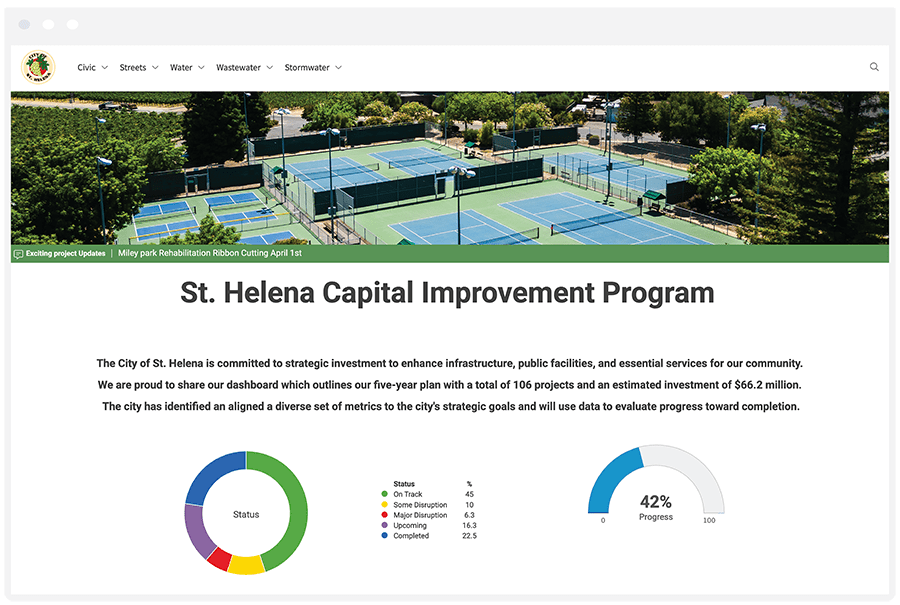
For community-facing work, project dashboards with interactive maps give residents and elected officials direct visibility: what’s happening, where, and how far along it is. The City of St. Helena uses Envisio to publicly display their progress on their five-year capital improvement program, covering 106 projects.
City of Minnetonka, Minnesota
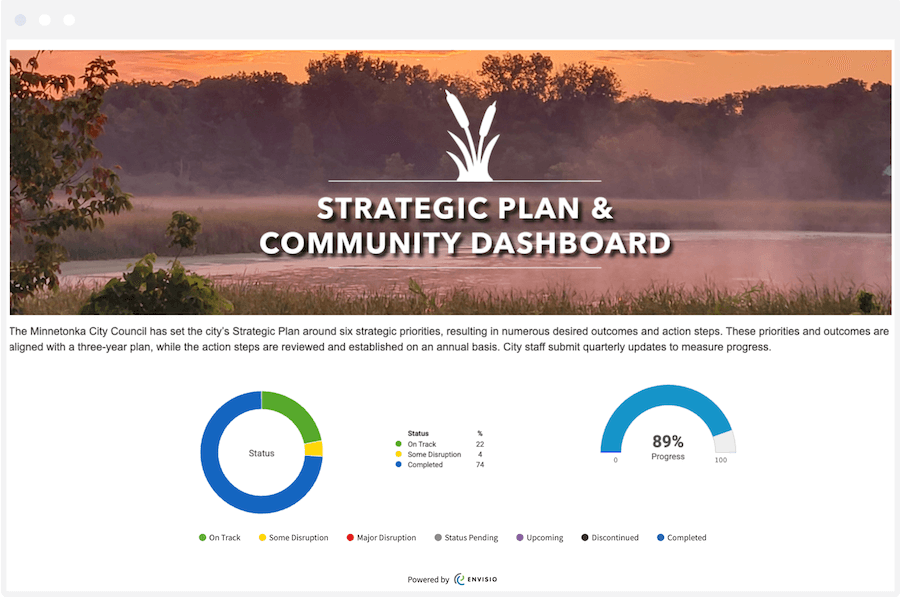
The City of Minnetonka‘s strategic profile organizes six priorities:
- Financial strength
- Public safety
- Sustainability
- Development
- Infrastructure
- Community inclusiveness
Each have defined outcomes and progress measures tracked publicly in real time. The community dashboard uses color-coding to show residents exactly where each item stands, updated continuously rather than on a publication cycle. It’s a great example of what it looks like when a city builds reporting discipline across multiple departments into managing strategy.
Regional Municipality of Niagara, Ontario
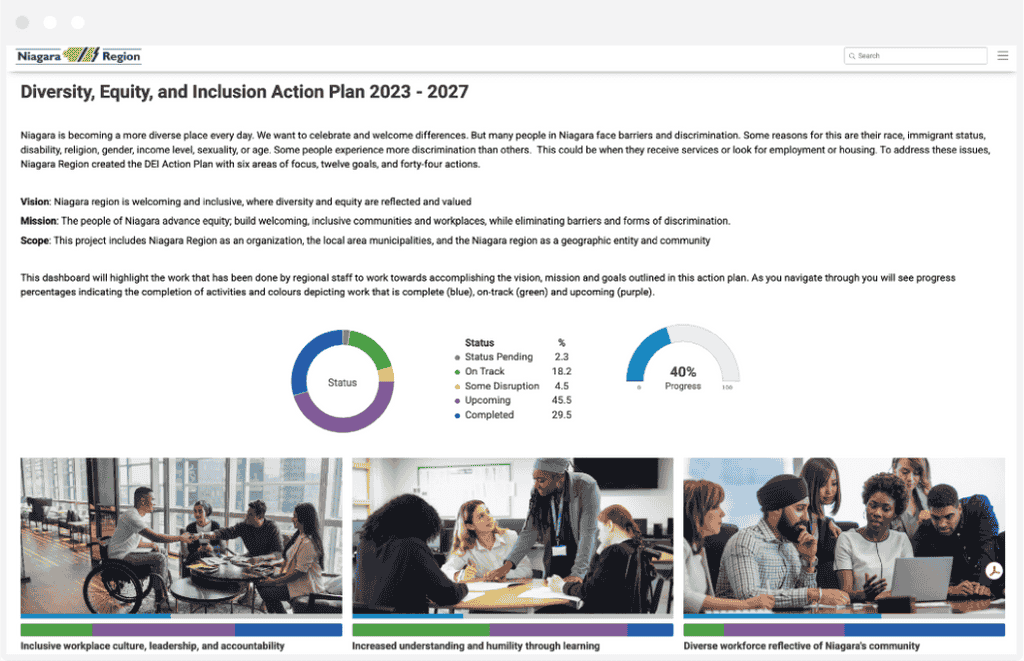
Niagara Region uses Envisio to track multiple plans simultaneously: a four-priority Council Strategic Plan running 2023–2026, a separate DEI Action Plan with six focus areas and 44 actions, and a community dashboard covering regional data. Each plan has its own public-facing dashboard with consistent progress tracking. That’s the operational argument for centralization—different plans, different scopes, different audiences, all held in one system with a shared reporting structure.
↓ Book a Demo
Cities and counties that manage multiple plans well have one thing in common: a shared system that keeps plans visible, ownership clear, and reporting running consistently, without the siloing, fragmentation, and manual coordination that comes from managing each piece somewhere different.
Book a demo today to see how Envisio can help.