
Schools these days are navigating many complex changes. Shifting enrollment, changes in funding, and a public that is watching closely to see what direction K-12 education is headed in, have all changed what the schooling landscape looks like in 2026.
School districts and independent schools that are able to come out ahead in this environment tend to have one thing in common: a clear plan that everyone—staff, families, and the community—can see and understand.
A strategic plan gives a school a way to answer three basic questions:
1. Where are we now?
2. Where do we want to go?
3. How do we get there?
Schools with a strong vision and plan are better equipped to retain students, secure funding, and build lasting trust with the community around them. In this post, we’ll cover what school strategic planning actually involves, why it matters right now, and how a strong plan, backed by the right tools, helps a school and its community thrive.
What a School Strategic Plan Actually Involves
School strategic planning is the process an individual school or district uses to set clear priorities, define measurable goals under each priority, and track progress toward them over time. A finished plan usually includes:
- A mission and vision statement
- A small set of strategic priorities (ideally three to six)
- Measurable goals and metrics
- Assigned owners and timelines
- A regular way to report progress to families, staff, and the board
Done well, a strategic plan becomes a living tool that guides budget decisions, staffing, facility upgrades, and ultimately, how a school communicates impact to its community.
Why This Matters for School Communities Right Now
The landscape is shifting, and planning ahead pays off
Enrollment patterns are changing across the country. Some districts have had to make devastating calls about consolidating or even closing buildings, as student populations shift and pandemic-era relief funding winds down.
The reality is that in the United States, districts closed more than 1,000 schools in the 2025-26 school year, up from 755 just four years earlier, according to National Center for Education Statistics data reported by the Washington Post.
These numbers underscore the reality of needing a plan that ties goals to real data and helps districts make informed, proactive decisions about resources, staffing, and facilities well before a budget shortfall forces a rushed one. For independent and private schools, the same planning discipline helps clarify what makes the school worth choosing.
Parents have more options than they used to
School choice policies are expanding, giving families more ways to choose the right fit for their kids. EdChoice’s 2026 Schooling in America survey found strong support for charter schools, vouchers, and tax-credit scholarships among both parents and the general public, with Education Savings Accounts (ESAs) polling as the most popular option. ESAs are the fastest-growing form of school choice policy, with 18 states running programs that serve more than 500,000 students combined.
That shift is a mixed bag. On one hand, there are more options for some parents—with some families being able to choose private or charter schools who otherwise wouldn’t have financial access. On the other hand, this shift may contribute to already constricted funding for fully public education.
When there are many paths to take, making sure your school or district has a strong strategic plan, paired with a public way to share progress, is a good idea. It gives a school a visible, compelling way to stand out when families are comparing choices.
Public confidence in schools is on the rise
Another interesting finding from EdChoice’s survey found that public optimism about the direction of K-12 education rose to 37%, up 6 points from the prior year and up 10 points since 2023.
This is great news; even when funding becomes tight for schools, the data suggest growing support for public schooling. Among school parents, optimism climbed to 43% in 2026, and the share who see K-12 education as headed in the wrong direction dropped from 64% in 2024 to 56% in 2026.
Confidence is building, and schools that communicate their progress clearly, through a public plan and regular updates, are well positioned to keep that momentum going with their own families and community.
Five Ways a School Strategic Plan Cultivates a Positive Community
A school does not operate in isolation. A strategic plan is often described as a document for the outside world, but it is more useful than that. The people it changes most are the ones inside the building. Here are five ways a strategic plan benefits a school community.
1. Creates Confidence in Quality Education
A strategic plan lays out a school’s mission, vision, values, goals, and objectives in one place. That clarity often creates trust, which gives families and neighbors confidence that the school is focused on a safe, well-run learning environment.
Staff stop working toward competing priorities. Department heads can point to the plan when deciding what to fund and what to cut. Families get an answer to what the school is trying to do for their child and how anyone will know if it worked. The plan also supports accreditation, which is the school community’s own assurance that the learning environment is safe and well run.
2. Communicates School Differentiation
Every school and every community has its own needs. A strategic plan spells out what makes a school different from others nearby by setting goals and priorities that reflect the specific culture, language, religious identity, and demographics of the families it serves.
That shapes decisions teachers and administrators make daily: who gets hired, what gets taught, which programs grow. Families see their own identity in the plan rather than a generic set of goals, which is a large part of why they stay.
3. Improves Student Performance
School strategic plans often include facility and campus upgrade goals, and the research on this is consistent. Students in substandard buildings tend to have lower academic achievement, and poor facilities have been linked to weaker teacher performance as well.
The reverse also holds true: schools with strong lighting, acoustics, and climate control tend to see better morale among students and teachers, stronger school climate, and better outcomes overall.
4. Supports Lasting Alumni Involvement
Strategic plans that include alumni engagement keep a school connected to its graduates.
Current students get mentors who sat in the same classrooms, co-op placements, and a clearer picture of what comes after graduation. The school gets volunteers, donors, and advocates who help recruit the next cohort. Alumni engagement is one of the few goals that pays back into the school year after year without new headcount.
5. Plans to Retain Quality Teachers
Teacher quality is widely regarded as one of the most important school-level factors in student achievement. A strategic plan that sets clear goals around hiring, retention, recognition, and professional development keeps a school focused on attracting and keeping strong teachers. A great teacher who stays and grows at a school can become role models for the whole community.
Steps to Build a Plan Your Community Can Rally Behind
Building a plan does not have to take many months or use expensive outside consultants, though many schools bring in facilitation help for the first cycle. This is oversimplified, but a workable process typically looks like this:
- Gather input. Survey staff, parents, students, and board members about what is working and what needs to change.
- Set three to six priorities. More than that and a plan becomes hard to track or communicate. This is often where schools will bring in an outside facilitator, however any staff member with facilitation expertise in structured, participatory meetings could run these. Choose who you want to be involved in creating the strategic plan. Executive sponsorship is important for staff buy-in down the line.
- Write measurable goals. Every priority needs at least one number attached to it, whether that is enrollment, test scores, facility upgrades, or funding raised.
- Assign owners and timelines. Every goal needs one person accountable for it and a target date.
- Report progress on a schedule. Monthly or quarterly updates to staff, the board, and the community keep the plan alive instead of letting it sit unused.
A plan is only useful if people can see it, believe in it, and act on it. Many schools now use dedicated planning and execution software instead of spreadsheets and slide decks that go stale within weeks.
The right tool lets schools assign goals to owners, track progress automatically, and generate reports for the board or the community without rebuilding a deck from scratch every quarter. Envisio’s strategy execution software is built for exactly this kind of ongoing plan management, and it pairs well with the planning process described above.
Real Schools Using Strategic Planning Right Now
The best way to understand what a school strategic plan looks like in practice is to see one in action. Here are two school districts with public-facing strategic plan dashboards today.
Both districts show the same pattern: a small set of named priorities, a public place to track progress against them, and regular updates that keep the plan active instead of letting it sit on a shelf.
Rowan-Salisbury School System: Renewal in Action 2028
Rowan-Salisbury School System (RSS) built a public dashboard around its five-year plan, Renewal in Action 2028, to give families, staff, and the community a live view of progress. The plan is organized around five priorities:
- Building Academic Excellence
- Growing Through Engaging Experiences
- Reinforcing Wellness
- Investing in Talent
- Supporting Organizational Foundations
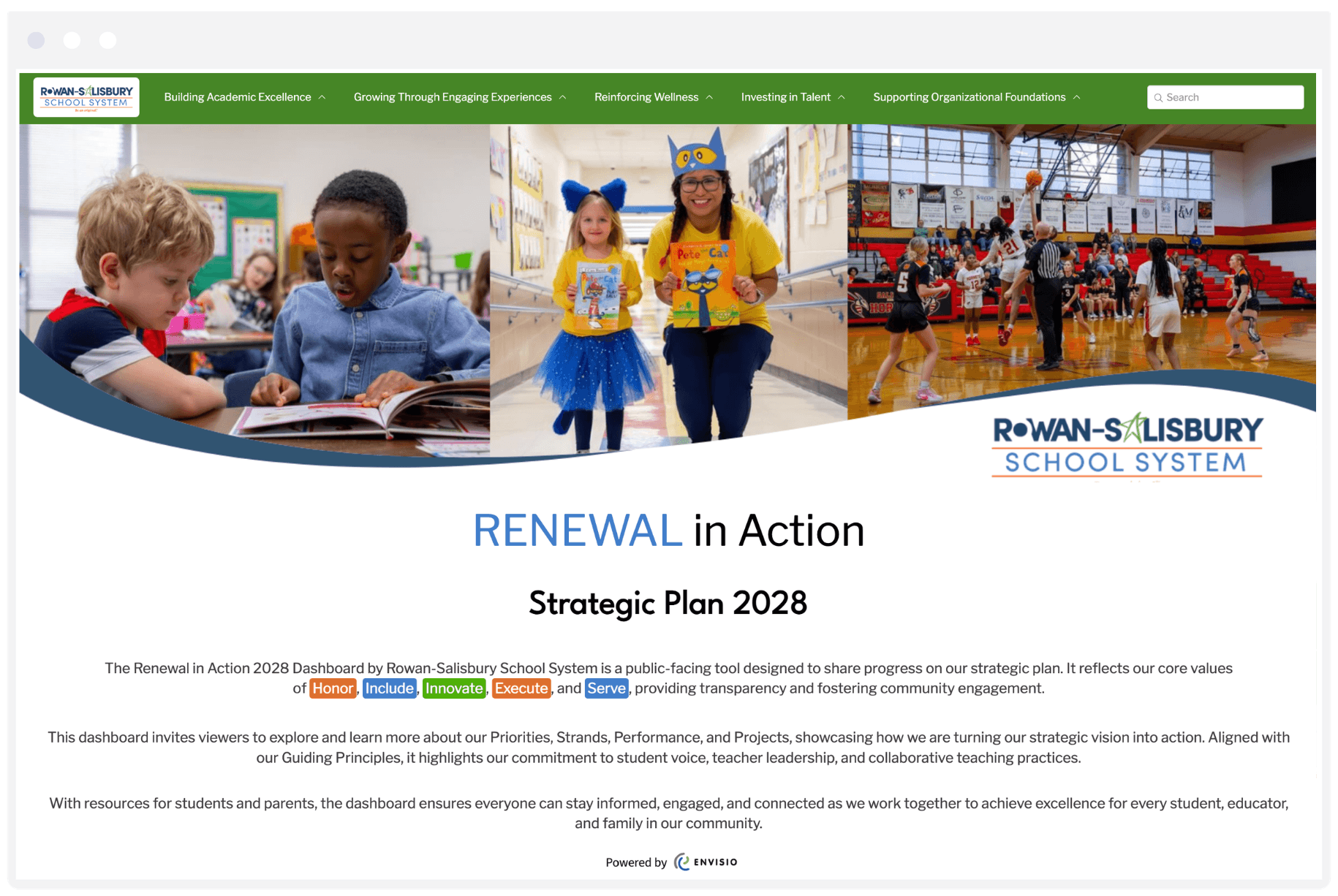
As of the latest update, RSS is 49% of the way through the plan, with 78% of strategies on track. Under Building Academic Excellence, one strategy that is focused on innovative learning models is 67% complete. Under this strategy. RSS launched a district design team to study new learning models, partnered with Transcend Education to shape the approach for a new school opening in fall 2026, and hosted a community showcase of the models in May 2025. The team is now using grant funding to send staff to see similar models in action elsewhere, and forming a community cohort to help guide the work going forward.
The dashboard also spells out RSS’s guiding principles, including student voice, a consistent adult advocate for every student, and protected collaboration time for teachers, giving the community a clear picture of how daily practice connects back to the strategic priorities.
West Northfield School District 31: Strategic Plan 2022-2027
West Northfield School District 31’s Board of Education approved its five-year strategic plan in August 2021, and the district has posted regular updates on their strategic plan public dashboard ever since, including updates for FY2024 and FY2025.
Like with Rowan-Salisbury above, West Northfield’s plan also centers on five goals:
Student Growth and Achievement, Supportive Learning Environment, Professional Practice and Shared Leadership, Family and Community Partnerships, and Finance, Facility, and Technology. The district is currently 63% through the plan, with 95% of strategies on track.
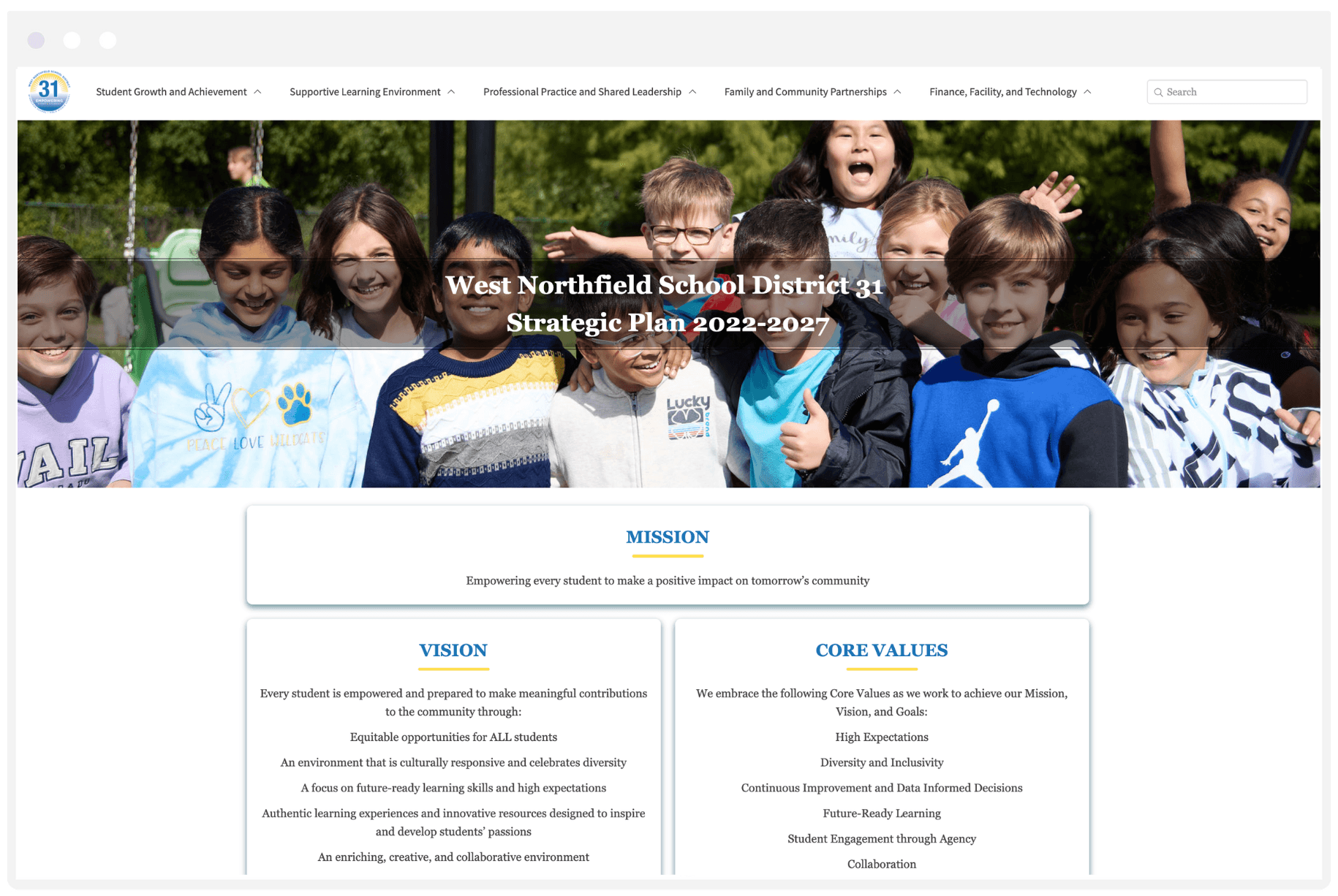
District 31 built its plan around a clear mission: Empowering every student to make a positive impact on tomorrow’s community. Their “Portrait of a Graduate” vision names the specific traits, such as critical thinking, resilience, and self-advocacy, the district wants every student to leave with.
The district worked with the Consortium for Educational Change to run the planning process, using a data retreat, a visioning retreat, and a direction-setting retreat to answer three questions in sequence: Where are we now? Where do we want to be? How do we get there?
—
Ready to put your plan into action instead of leaving it in a document? Book a demo to see how Envisio supports strategic planning for schools and districts.